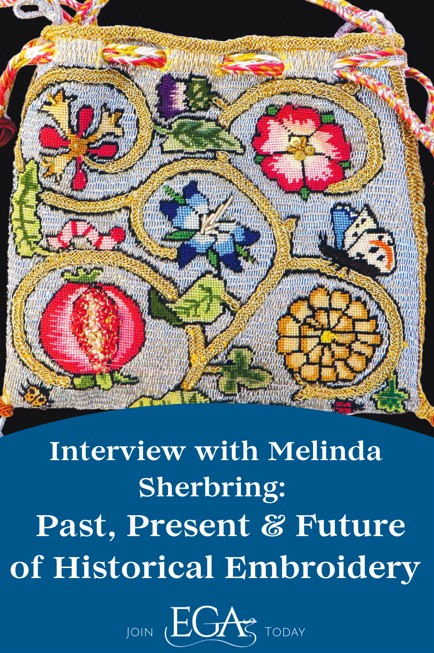
For our latest interview in our Teacher Interview Series we sat down with Melinda Sherbring for a fascinating look into the past, present and future of historical embroidery. Melinda is a frequent teacher at EGA national, regional and chapter events and her group correspondence course Sweet Bag Sewed of Silver and Gold is available for registration to individual members through May 31, 2025.
You have a fascinating history! You were a software engineer in the aerospace industry for almost 40 years, during which you led a team working on part of the ground station for the Hubble Space Telescope. You are also a member of the Society for Creative Anachronism, an immersive history group where members dress in period clothing, engage in tournaments, royal courts, feasts, and dancing, and learn how to recreate crafts and skills of the pre-17th century world. How were you introduced to embroidery?
I first tried embroidery as a teenager in the mid-1960s. It was crewel, primarily through Erica Wilson’s books and, I think, some of her kits. My sister Marta was the artist in the family, so I stitched pillows for high-school friends based on her drawings.

I then set aside embroidery for awhile. I moved away from home in Albuquerque, New Mexico, to Los Angeles in 1975 to work at an aerospace firm. I connected with the local SCA group, where I often dressed as a lady of the late 1500s and pursued my crafting joy of researching and doing calligraphy & illumination similar to first century AD British Isles examples. In the mid-1980s, an SCA friend introduced me to counted cross stitch, which hooked me on embroidery again.
In 1991, I discovered both EGA and ANG, and became a founding member of my local EGA chapter, El Segundo Blue (named after a local endangered butterfly).
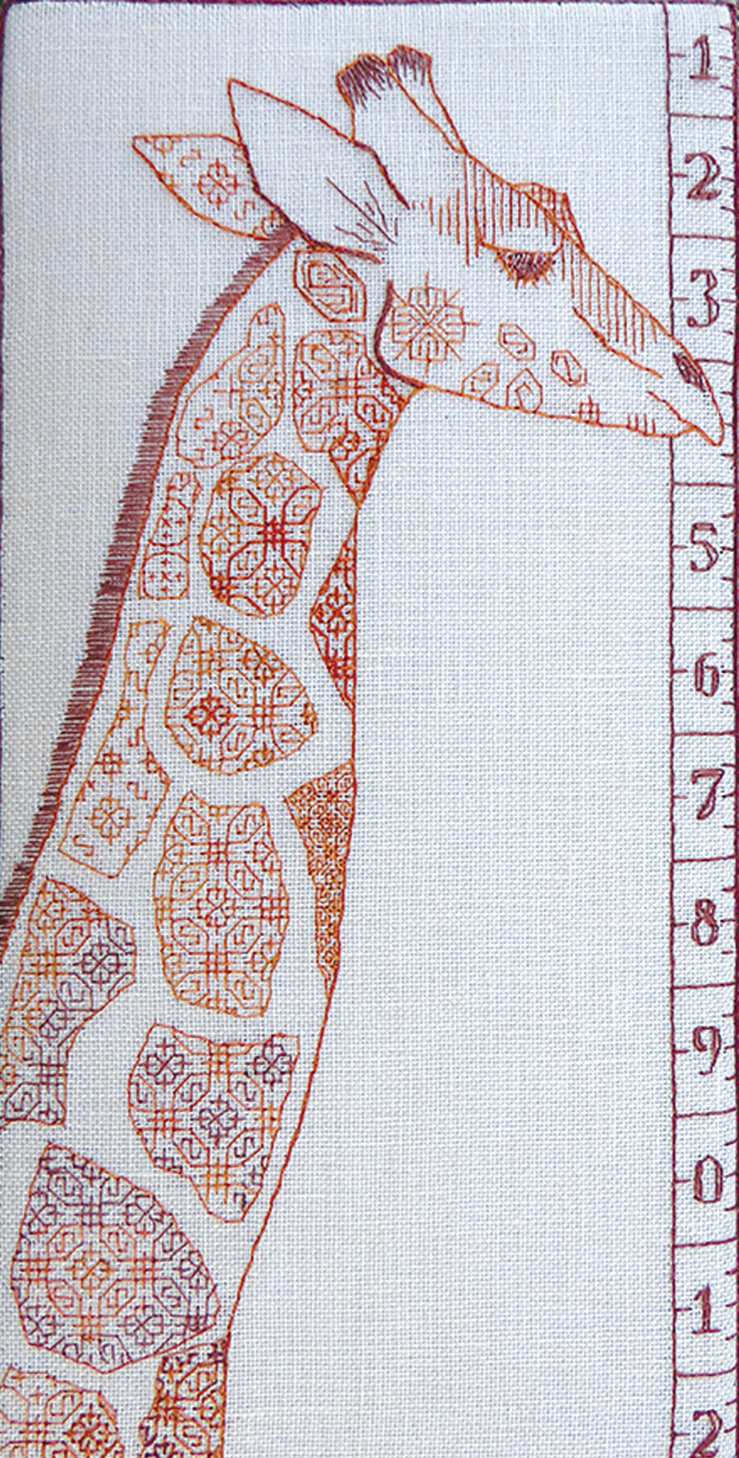
I started going to EGA national seminars in the mid-90s, where I met many knowledgeable teachers. Among them were Marion Scoular, who taught me about blackwork beyond just decorating the cuffs and collars of my Elizabethan clothing. I also met Chris Berry, who introduced me to Tudor stitches. But I had to wait till Leon Conrad’s 2003 articles in Fine Lines magazine to see how he analyzed the Plaited Braid stitch in existing pieces. Those articles introduced me to the possibility of figuring out stitches from historical examples.
Do your interests overlap in any interesting ways?
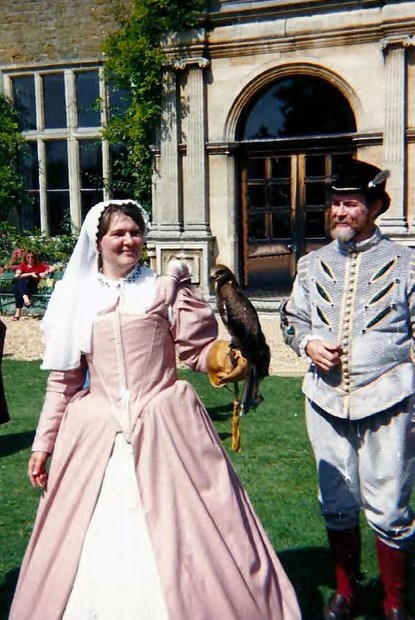
In 1988, I joined a performance troupe, Past Times with Good Company, composed of mostly SCA folk. We were specifically hired to be entertainment at various Elizabethan houses as part of the nation-wide celebration of the defeat of the Spanish Armada 400 years previously.
We danced English Country dances, played music, and demo’ed Renaissance skills. I demonstrated calligraphy and cut quills to make pens. We entertained at a feast in Plymouth, playing local-to-them historical personages. We performed as 1588-costumed historical interpreters for 2-3 days at Buckland Abby, Coomb Sydenham, Hatfield Hall, Haddon Hall, Wingfield College, Sudeley Castle, and other venues. It is now common to see these kinds of historical re-enactors in British historical sites—the Past Times troupe was one of the early performance groups to do that.
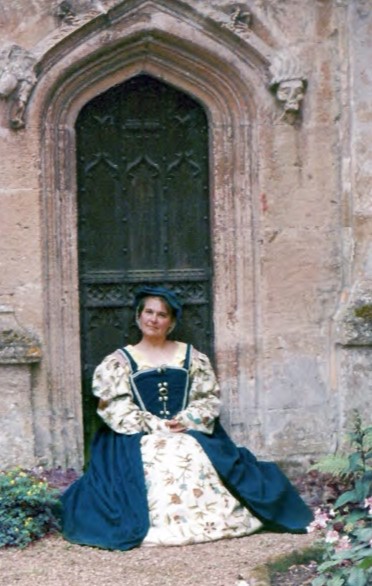
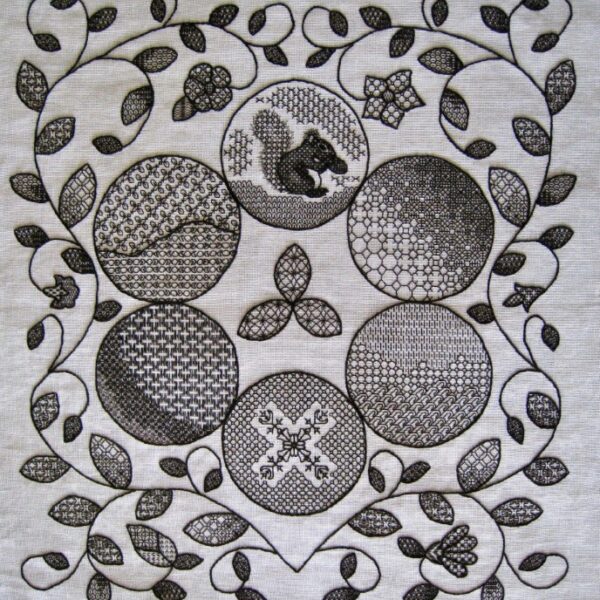
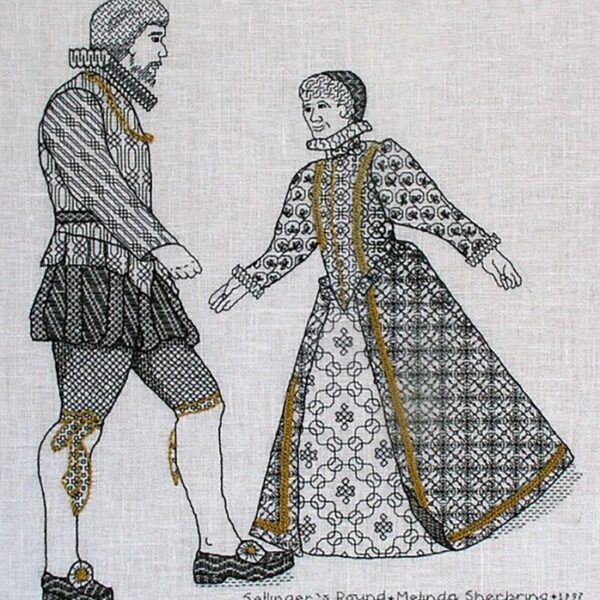
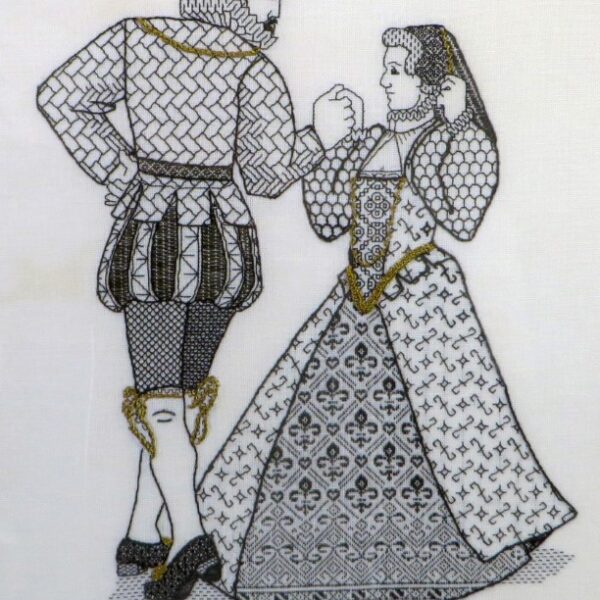
This is relevant because photos from the tour formed the basis for some of my later blackwork designs, such as these English Country dancers (below). The realistic drawings and the methods of shading diapered fillings by thread weight or by pattern completion is basically an historical subject worked using modern blackwork styles.
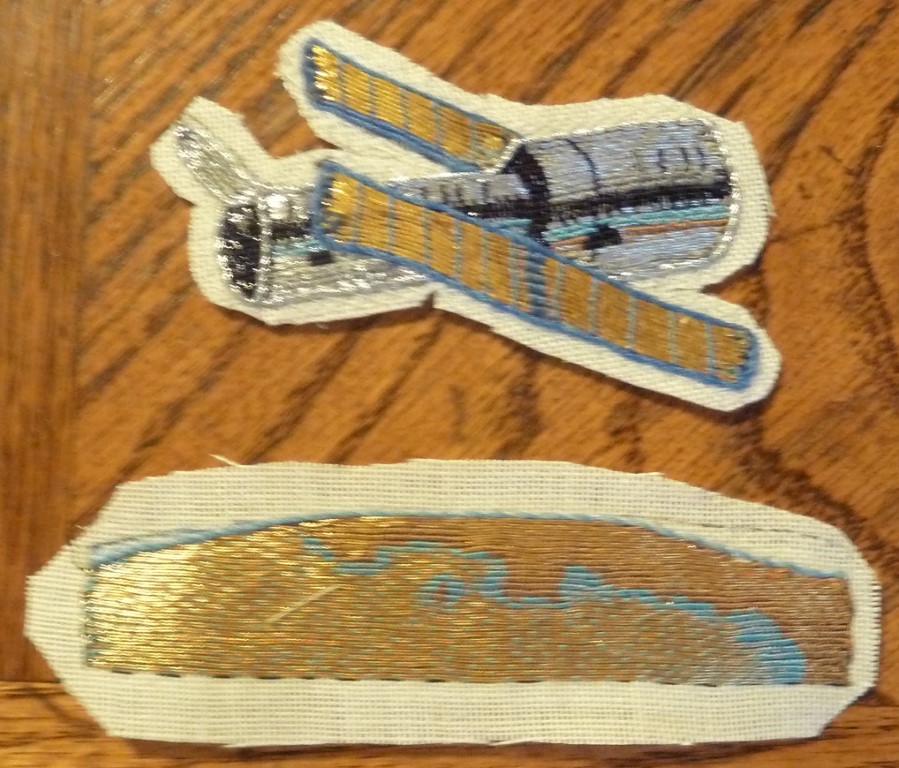
I have also worked a modern subject (the Hubble Space Telescope) in an historical embroidery style (Or Nué over a padded ground). This was in 2013 for EGA Challenge with a Twist. The challenge was “How can traditional work be changed to fit into modern times?” I saw this as, “How can a symbol of the modern world be transformed into something that feels important by virtue of its treatment in a traditional way?”
In the European Middle Ages, books were rare and they were cherished for the treasures they were. The finest artists of the age illustrated them; many had jeweled and decorated bindings.
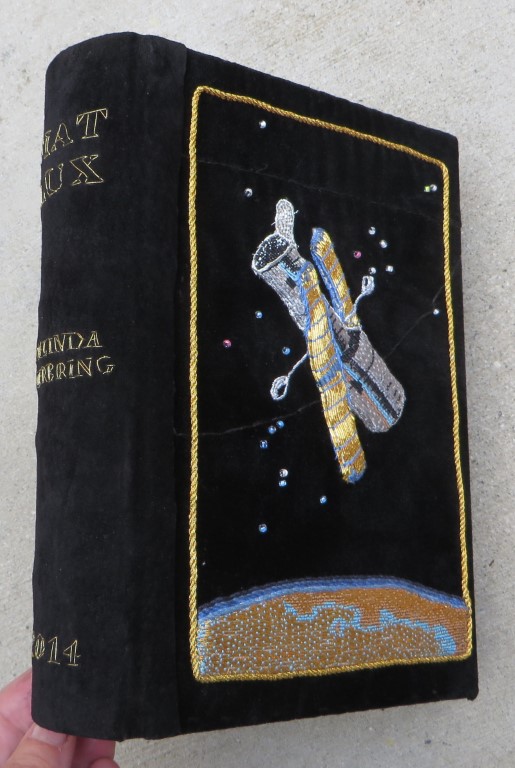
My goal was to do a book cover that would echo the reverence for knowledge and for books that was part of the Middle Ages. It would cover a commercially produced book box big enough to hold my Kindle(s).
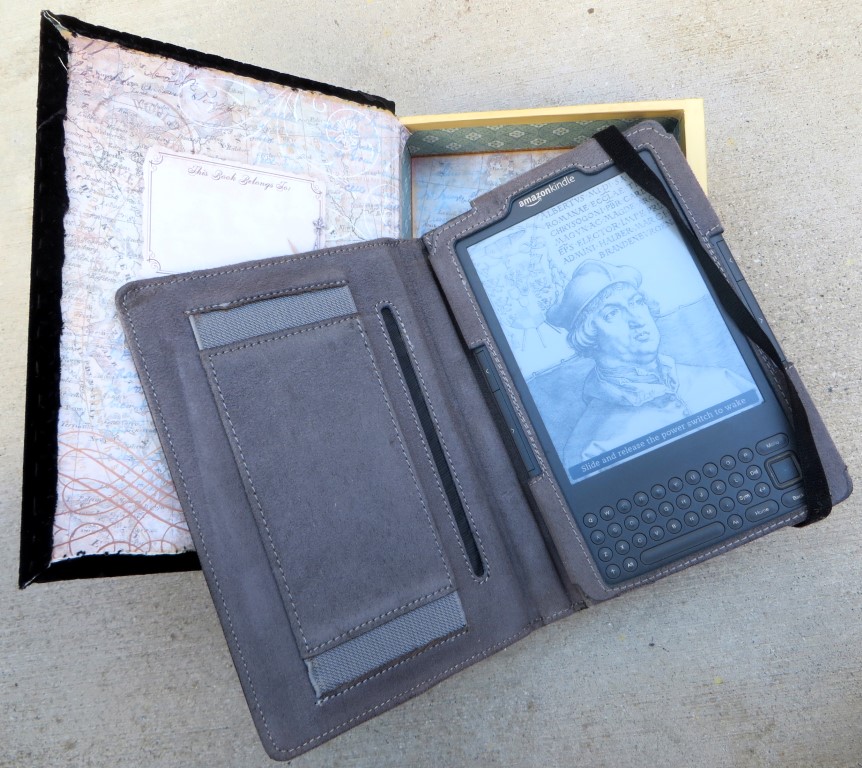
The design’s name is “Fiat Lux”, or “Let There Be Light.” This references the metaphorical meaning of dispelling ignorance through the knowledge contained in books. It also references the literal meaning that unlike the books of the Middle Ages, the books inside this cover are made of light instead of ink and paper. Finally, the embroidered picture was the very modern orbiting telescope that sees deep into the universe, capturing photons that are close to the first light of the universe: the Hubble Space Telescope.
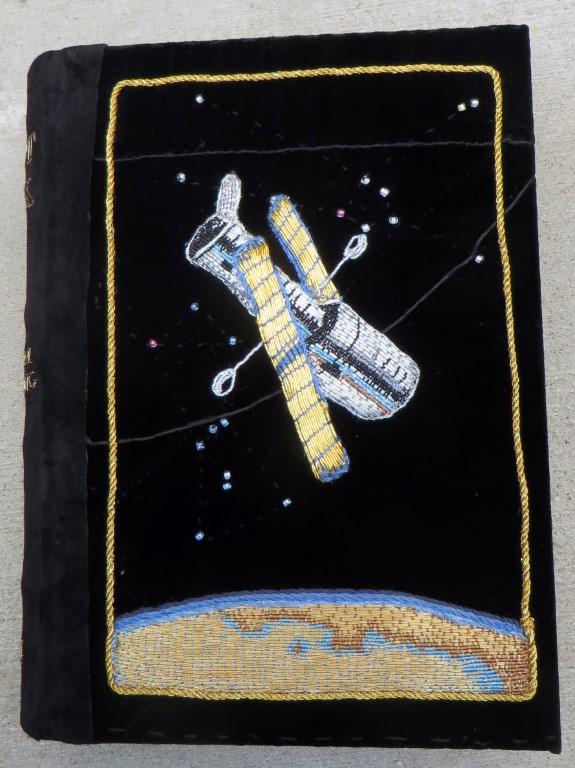
Atop this are the stars (tiny Mill Hill beads) from the zodiac constellation of my birth (Taurus). Next to Taurus is one of the most identifiable constellations in the Northern sky– Orion the Hunter. Silver or white beads pick out most of the stars, with blue beads for the blue stars (such as Bellatrix and Rigel) and red beads for the red stars (such as Betelgeuse and Aldebaran).
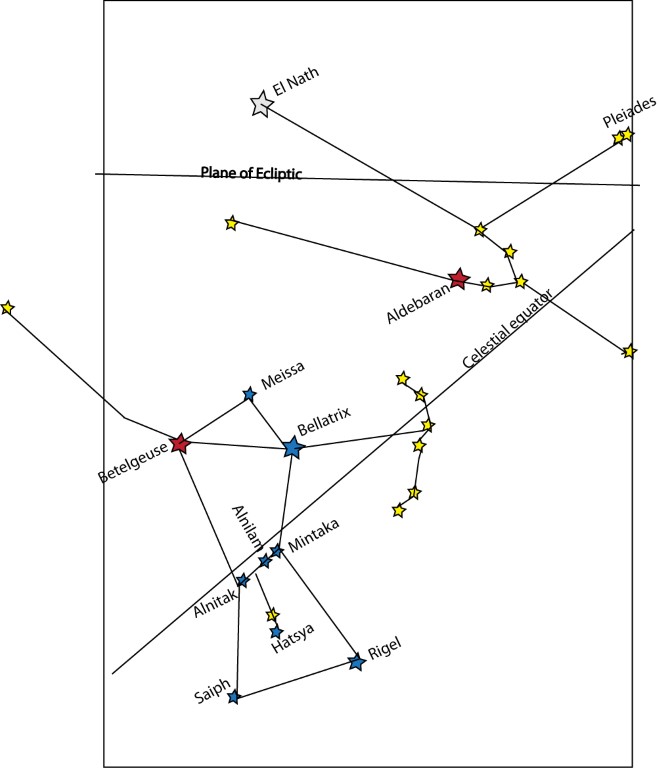
Through these constellations run the invisible lines of the plane of the ecliptic and the celestial equator. The plane of the ecliptic, scientifically speaking, is the plane of the Earth’s orbit (and broadly speaking, of the whole solar system) around the sun. In an Earth-centric view, it is the apparent path of the sun through the zodiac. The celestial equator is the plane of the Earth’s equator, extending outwards through the celestial sphere. These invisible lines are each represented by a black thread stitched against the black velvet.
For the limb of the Earth, I used a picture of Southern California, where I live, taken from space and oriented to match the celestial equator.
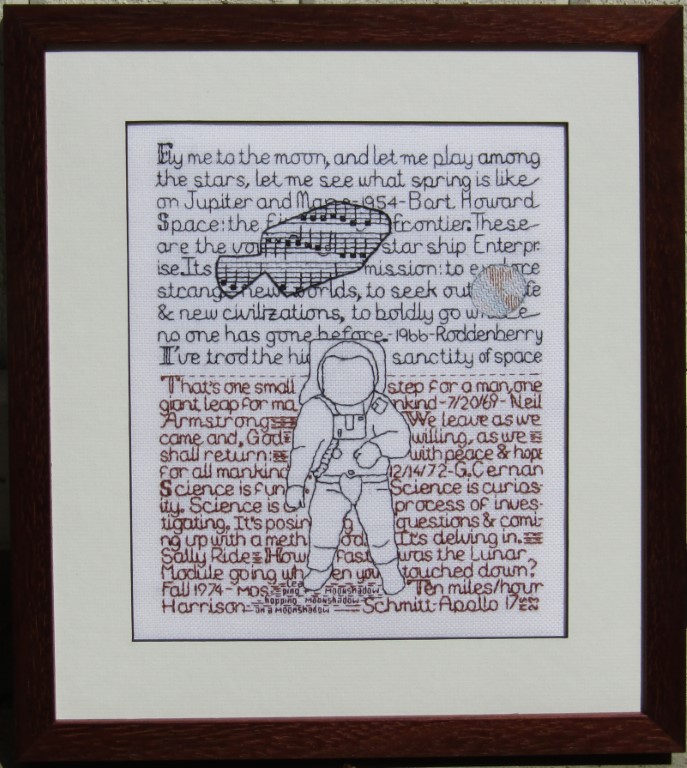
Last year I created a piece for EGA’s Through the Needle’s Eye Exhibit that combines my fascination with space, modern culture, science fiction, and blackwork. I call it Moon Shadows. I may as well answer the question everyone asks about Moon Shadows. The music was written by David Bowie, for the part of his 1969 song Space Oddity, that says, ” I am sitting in a tin can, Far above the world…”
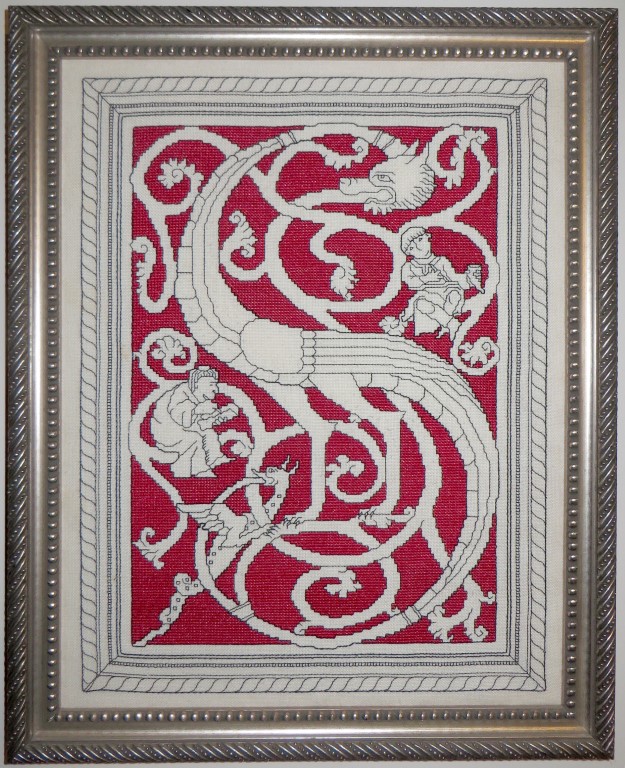
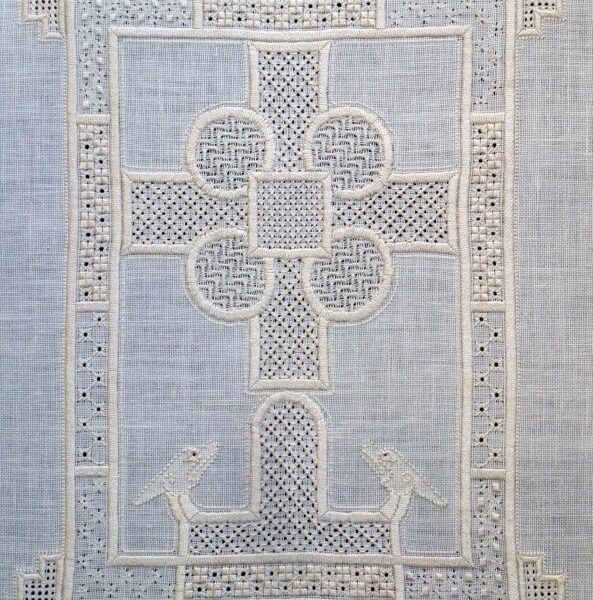
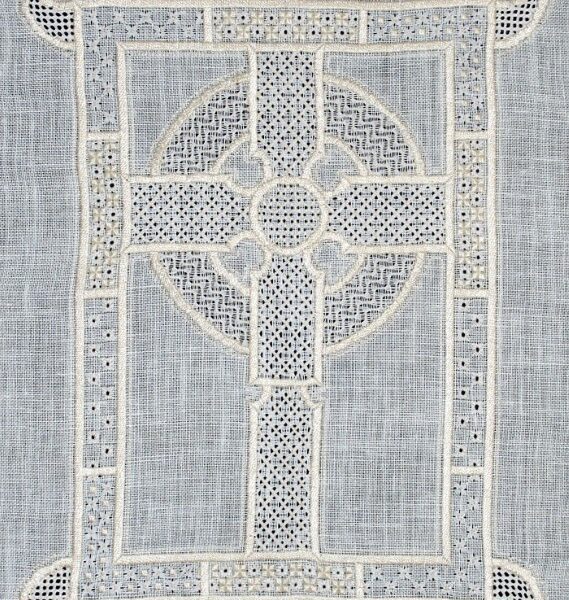
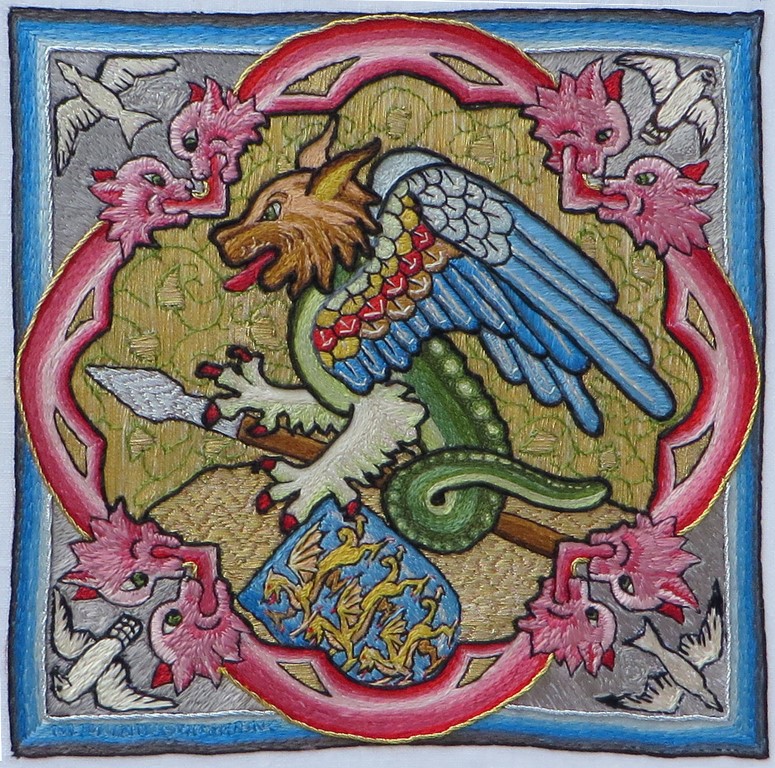
I have other cross-over designs, as well. The designs I created for various EGA Master Craftsman program steps were also strongly inspired by historical images: Step 1 was a tribute to the Lindisfarne Gospels, step 2 to Italian white vine illumination style, with two dragons and two scribes, step 3 to two different Pictish carved stones placed within frames similar to those in Insular illuminated manuscripts, worked in pulled thread—I liked the idea of recreating a massive stone design with a delicate lacy technique.
What drew you to historical styles of embroidery? What are your favorite styles of embroidery?
My involvement with the SCA has drawn me into historical clothing, writing, heraldry, music, dance, and martial arts, as well as embroidery.

Favorite embroidery styles: Blackwork, Elizabethan raised embroidery, Or Nué, Opus Anglicanum, some stumpwork.
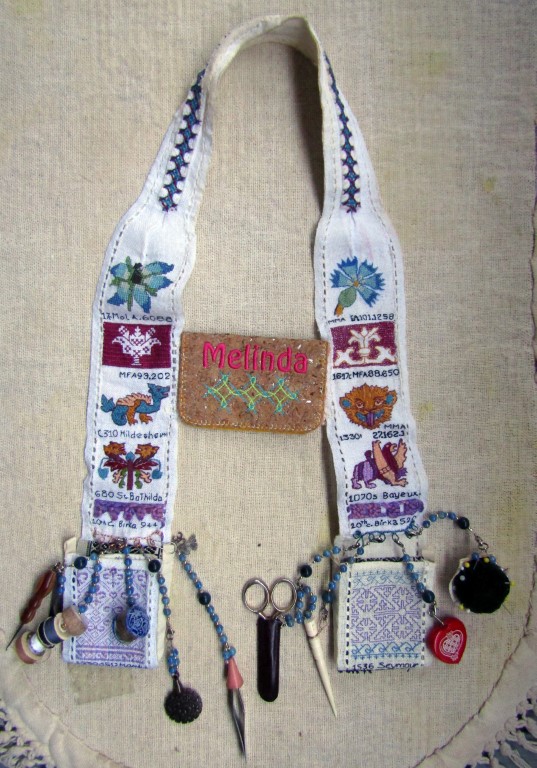
Here is my modern chatelaine (below), highlighting various historical bits of embroidery that use a single main stitch. The needlebook-name-tag in the middle was machine-stitched by Marianne Saraceno. She made nametags for all participants in our local chapter’s annual fundraiser. I repurposed it as a “morse” (cope clasp) to hold the two sides of the chatelaine, so it doesn’t fall off while I’m wearing it.
What does your design process look like?
It varies. I collect stitches. Sometimes I notice a stitch or series of stitches that I have never seen in modern items – so I want to create something so I can use them. Or I see familiar stitches used in unusual ways historically and want to try them out. Or I need an historical costume accessory and start figuring out what I want my version to look like.
Do you have a daily/weekly practice that you’d recommend to other embroiderers interested in honing their craft?
Call it more an approach than a weekly practice. Stay curious. Ask questions. Look at historical pieces, in photos or in person. Jump down research rabbit holes and see what you find.
Try out new stitches, especially complex ones, at a large scale first. I use 7-count plastic canvas and braiding cord to figure out and get comfortable with how stitches are made. When I’m comfortable with the shape of the stitches, then I work them at normal size with more authentic materials, such as metal passing threads.
You have a special interest in Elizabethan embroidery, sweet bags in particular. What are sweet bags, and why are you drawn to them?
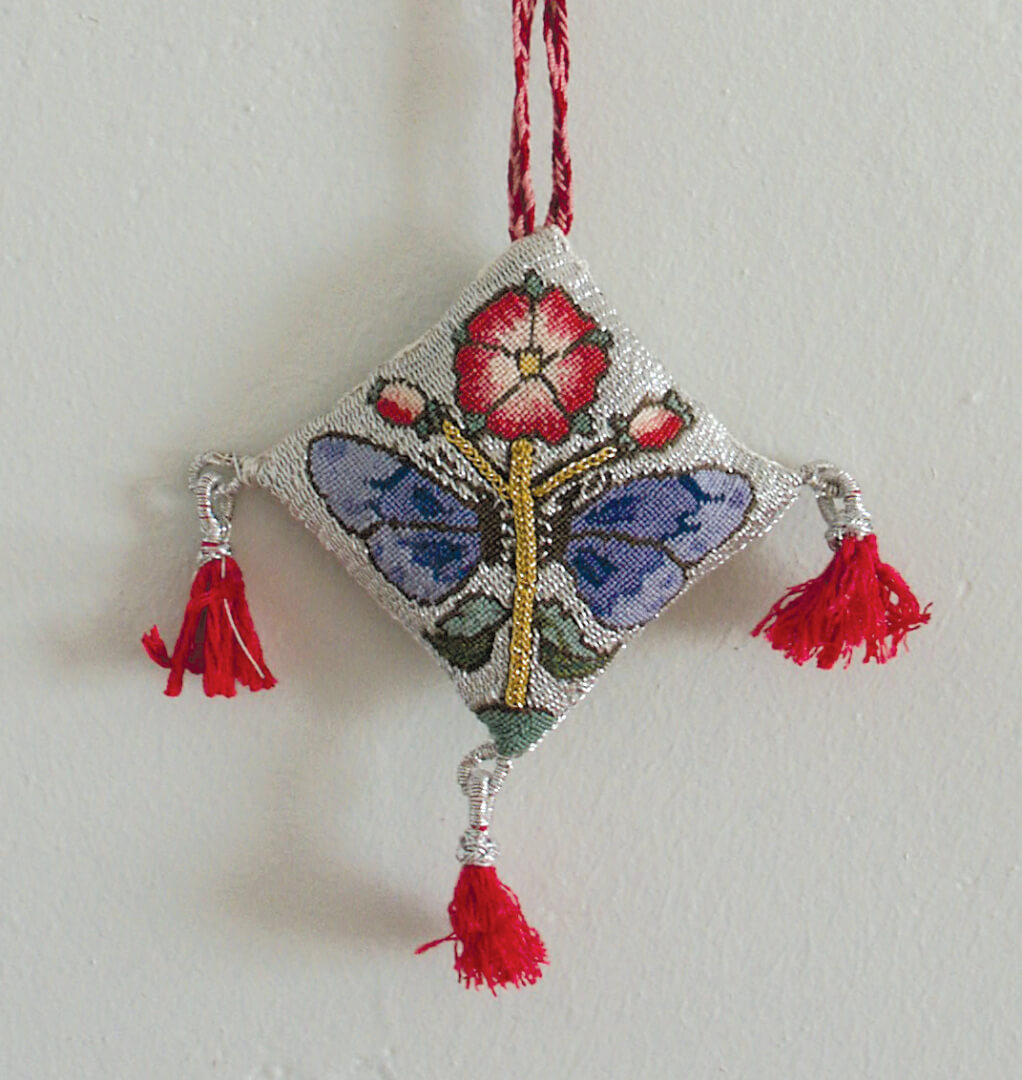
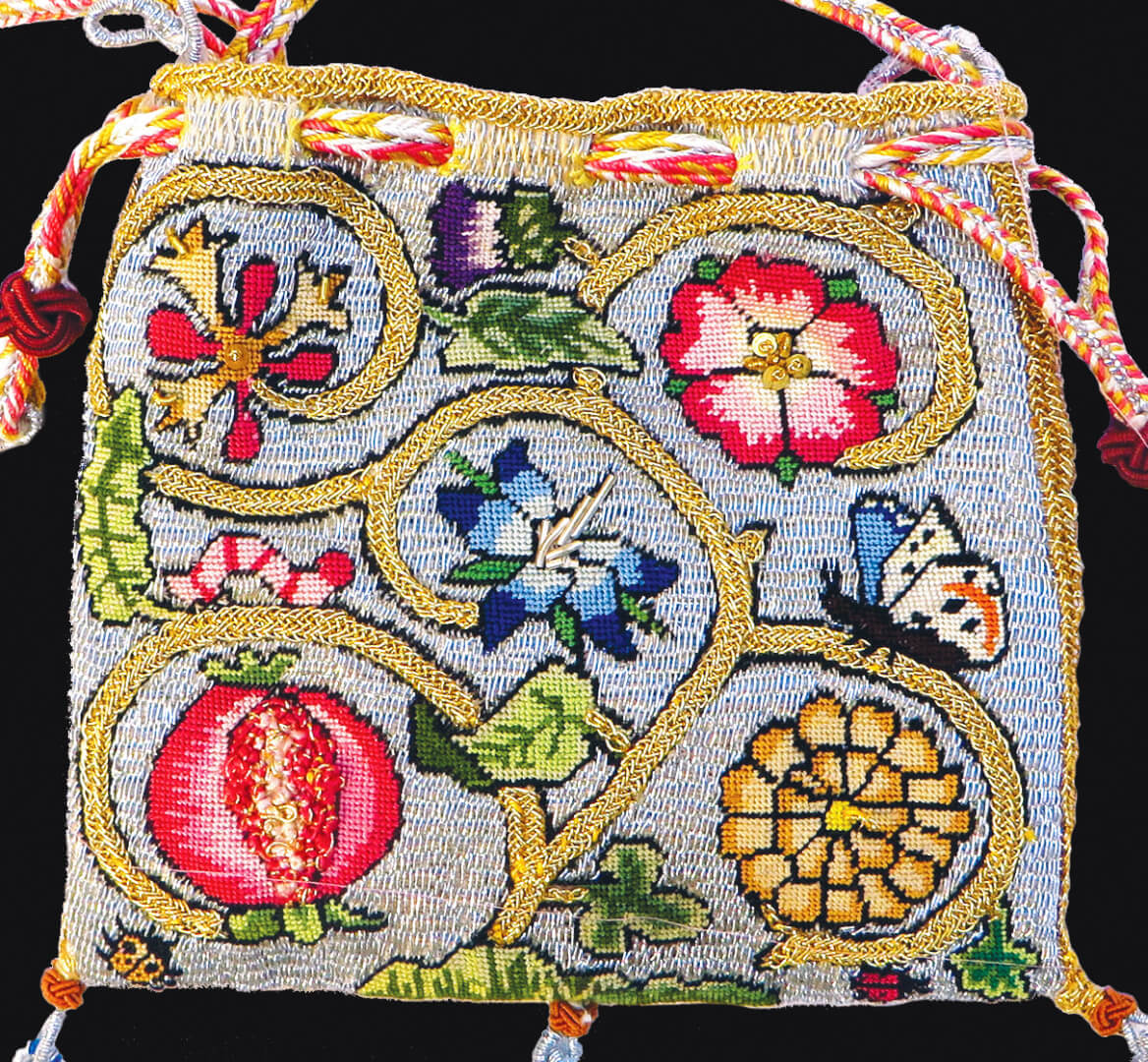
“Sweet bag” is a term used in the 16th and 17th centuries for a small square bag about the size of a CD case. They often held sweet-smelling herbs, but have been known to hold money, gaming pieces, or anything a small drawstring purse might legitimately hold. Many of them were elaborately embroidered, and there are different styles.
In the late 1990s, Pat Berman asked if I would consider piloting a new ANG program called Master Needle Artist. That sounded interesting, so I started looking at Elizabethan embroidery and settled on sweet bags. Then, as part of their planning for this program, word came to not do Elizabethan embroidery in the pilot class. I was disappointed, but figured this was an opportunity to research them on my own. So I did.
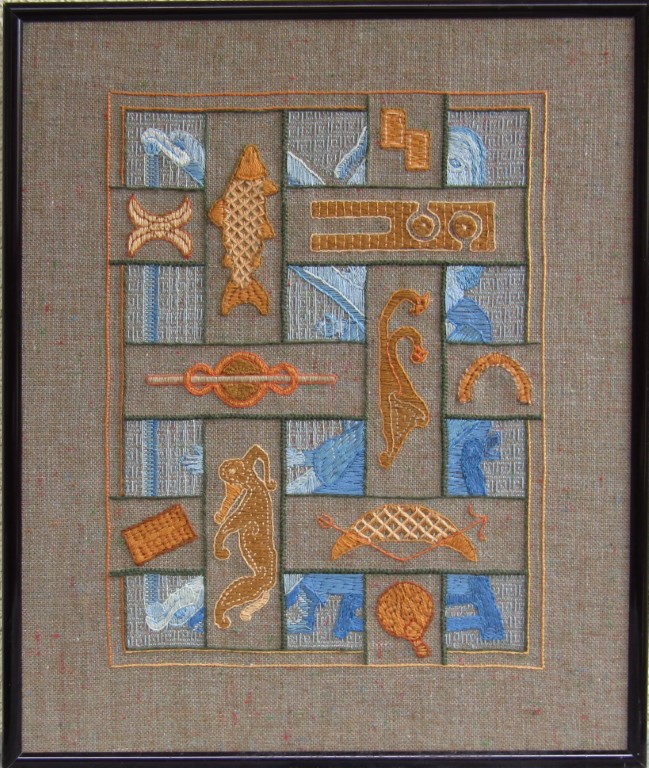
For the MNA pilot, I ended up doing wool embroidery with a very modern use of ancient Pictish designs. It is intended to allow the viewer a glimpse of Pictish culture (the harper carved on a Pictish stone in the basement of Edinburgh’s National Museum of Scotland) through a screen of typical designs from Pictish symbol stones that even now stand in fields, church yards, and beside roads, as well as in museums.
Back to sweet bags. In November, 2003, I went on a needlework tour of southern England led by Linn Skinner. A few months before, I contacted the V&A to arrange a day of looking at every sweet bag that they had in their collection that was not on display. I chose to skip the tour group’s day at Hampton Court Palace and the RSN. Two of us went to the V&A that day instead. It was glorious.
Shortly thereafter, I started writing a book about what I’d seen. It took a while to write, and I eventually submitted it to a publisher in 2009. While they were reviewing my manuscript, Jacqui Carey’s book Sweet Bags came out. So the publishers said “no thanks” to my manuscript.
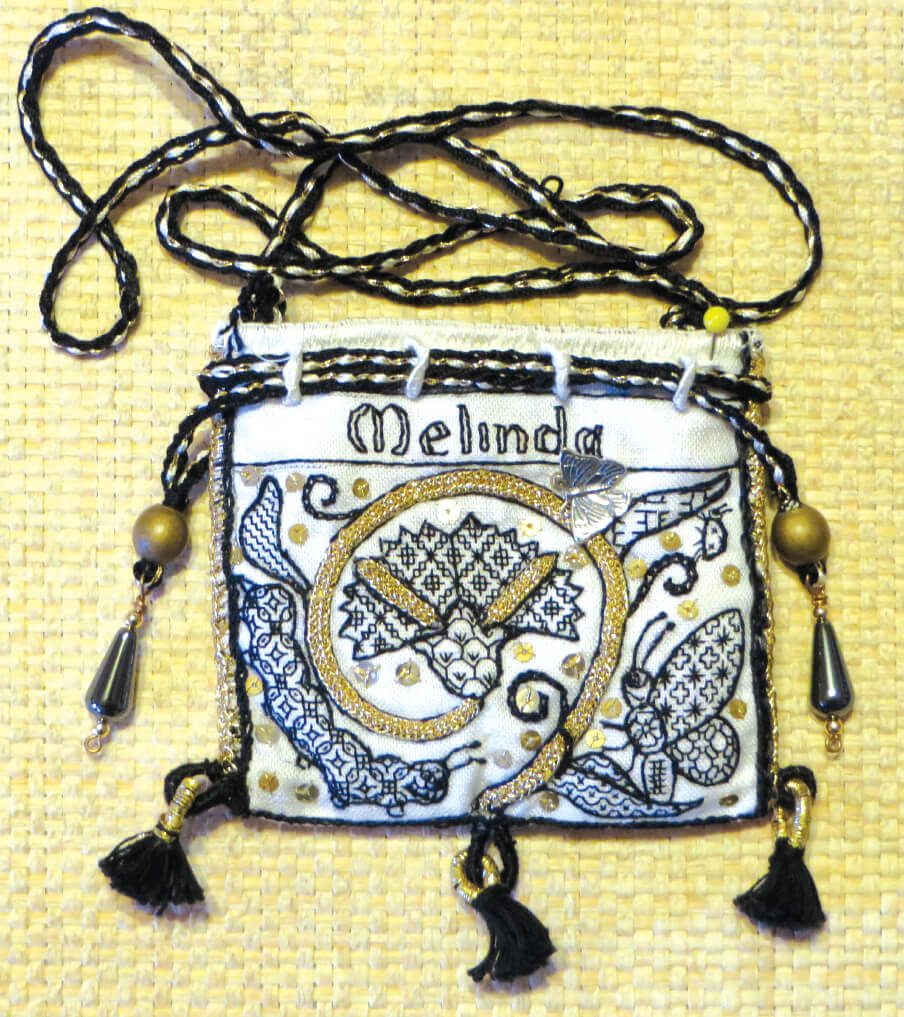
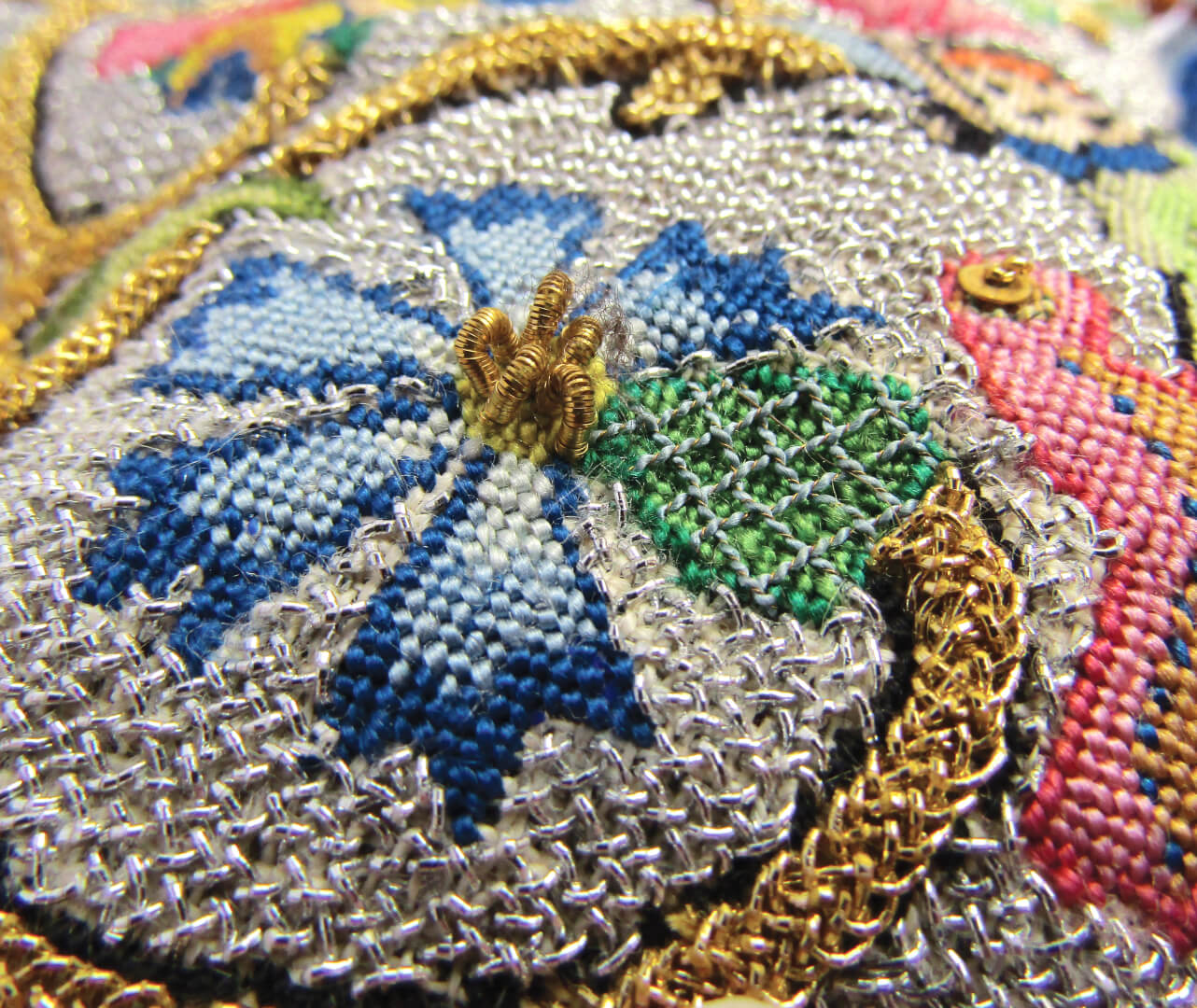
I think there is room in the world for more than one book on historical sweet bags. The Sweet Bags Sewed GCC is a project derived from my research, focused on a specific style of bag—one embroidered with polychrome silk and metal thread and focused on flowers. I do expect to return to the original manuscript, which covers additional styles of bags, and focus on examples found in American museum collections.
What do you hope stitchers take from Sweet Bag Sewed of Silver and Gold?
An appreciation for Elizabethan embroidery. For those who do historical re-enacting, this is very much in the historical tradition. It is small enough to be achievable in a reasonable amount of time, and the stitches, except for Plaited Braid, are generally not too difficult. Plaited Braid does take some getting used to.

Do you have a favorite embroidery design from your portfolio? Why is it your favorite?
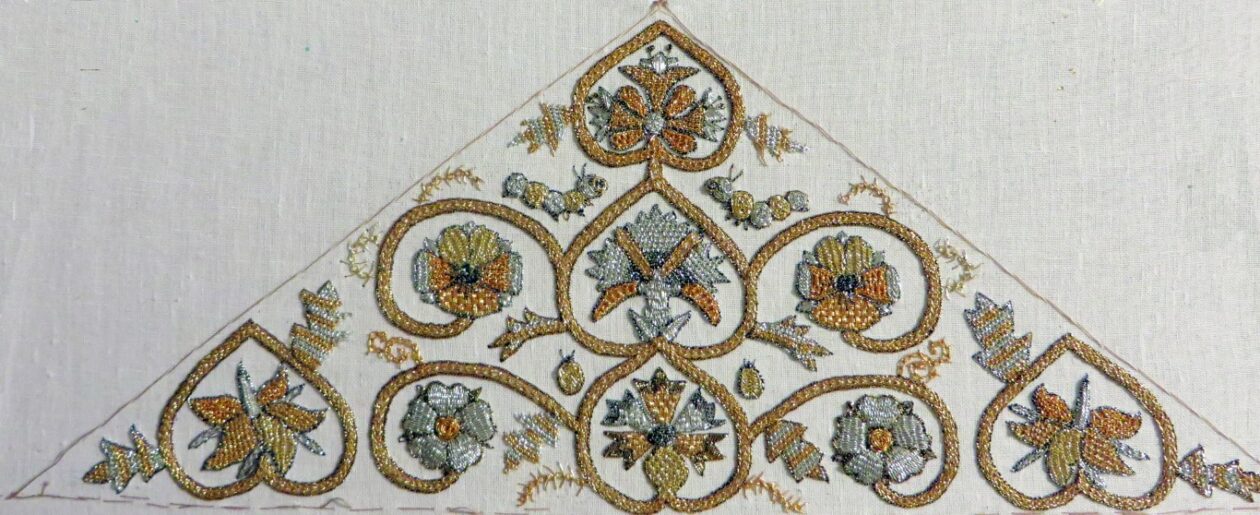
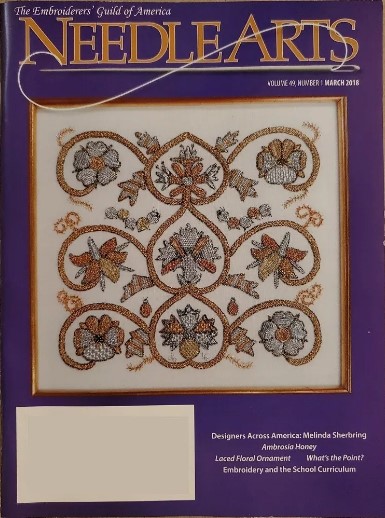
Hard to choose, but I do love to wear my forehead cloth. It was taught as a choice between rectangle shape for framing, or triangular for wearing with Elizabethan garb. The rectangular version appeared on the cover of the March 2018 Needle Arts magazine. Only one person in the Seminar class that year chose to work the triangular version. It’s my favorite because it uses lots and lots of fun stitches, and I do wear it, even though it is not washable.
Do you have any projects or events coming up we should keep an eye out for?
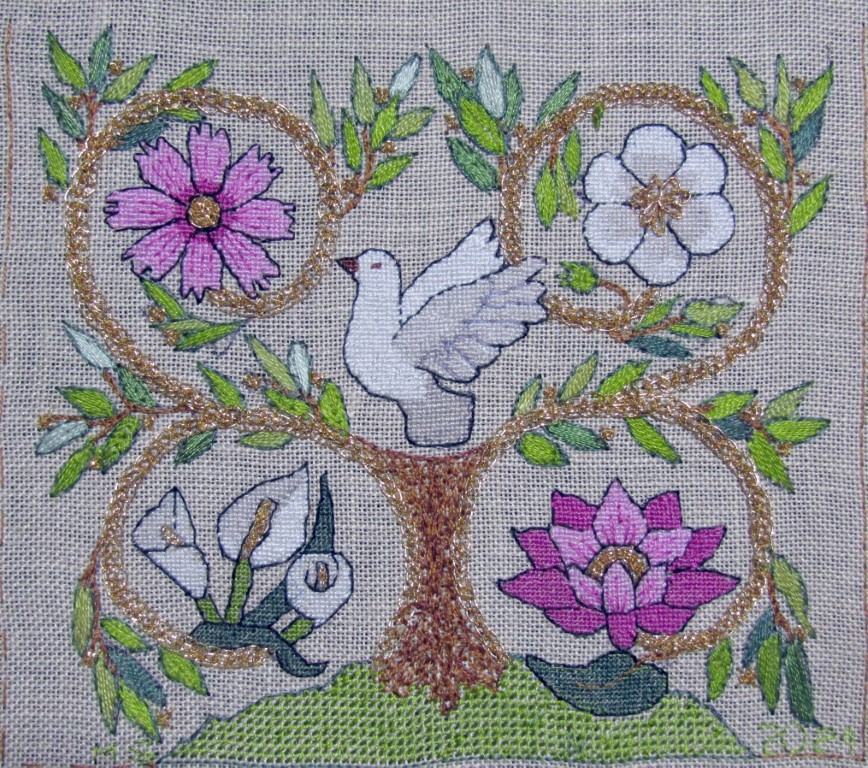
I designed the Pacific Southwest Region’s Yearly free project for 2025. Instructions went out to all PSR members late last year, and it will be available for purchase as a pdf in Oct 2025. EGA will announce notice/order info their newsletter and on the PSR website: psrega.org. It is one side of a sweet bag worked in the design style of a tree of flowers.
The project is called “Peace Purse,” since the tree is an olive tree with a dove rising in the center, and the branches spiral around flowers often associated with peace, such as peace lilies, lotus, peace poppy, and cosmos. It has some gold Elizabethan stitches (mostly based on chain stitch), and polychrome silk petit point and satin stitch. Unlike most historical sweet bags, it shows the linen ground fabric as the background, instead of covering it in silver stitching.
I recently agreed to teach an EGA Virtual Education course for Triple Lily Ornament, coming in mid-April 2026. Watch Needle Arts for the notice and sign-up information.
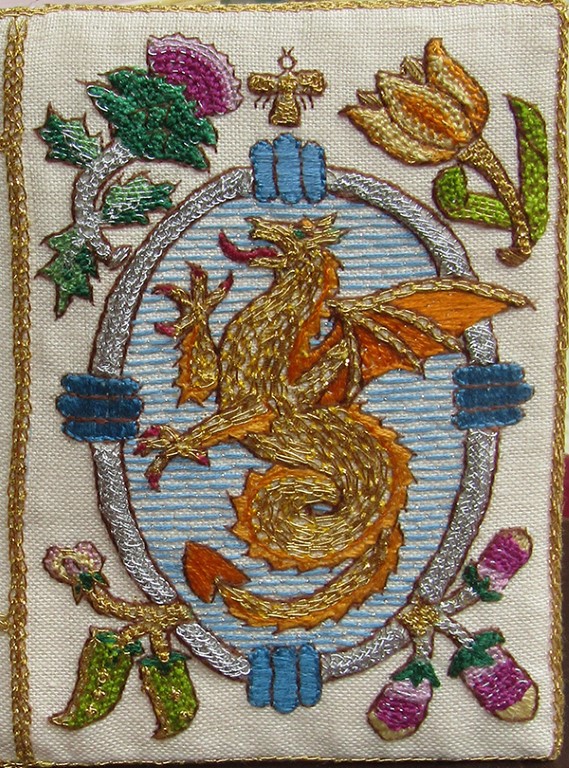
I also have an upcoming new GCC called “Uncommon Stitches.” It is based on an Elizabethan embroidery program I taught in early March 2020 for the EGA ESP (Extended Study Program) as a book cover. The GCC will feature the front cover as a panel.
Where can interested needleworkers discover more of your work and upcoming projects and events?
Papers about individual items I’ve seen and written about are posted on Academia.edu.
I am a co-admin on the Facebook group Historic Hand Embroidery.
I also have a really old website that needs updating called ThreadsofHistory.com.