Technique: Mountmellick
Place of Origin: Ireland
Earliest known date: circa 1825
History: Mountmellick embroidery, also called Mountmellick work, is a relatively young form of whitework embroidery. In fact, it is so young that we know the name of its creator: Johanna Carter, who developed the style around 1825 and taught it to a small group of approximately 15 women!
Mountmellick embroidery is named after the southern Irish town of Mountmellick, where Carter ran a Quaker school. The school taught girls and young women different styles of embroidery as a means for generating income to pay for their books and education.
In 1880, a Quaker named Mrs. Millner established an industrial association to provide “distressed women” with work. By 1890, the association employed 50 embroiderers, who stitched Mountmellick embroidery and other needlework and helped increase the technique’s visibility and popularity. Mountmellick embroidery was used in household linens like bedspreads and tablecloths, doilies, cushion covers, and other coverings.
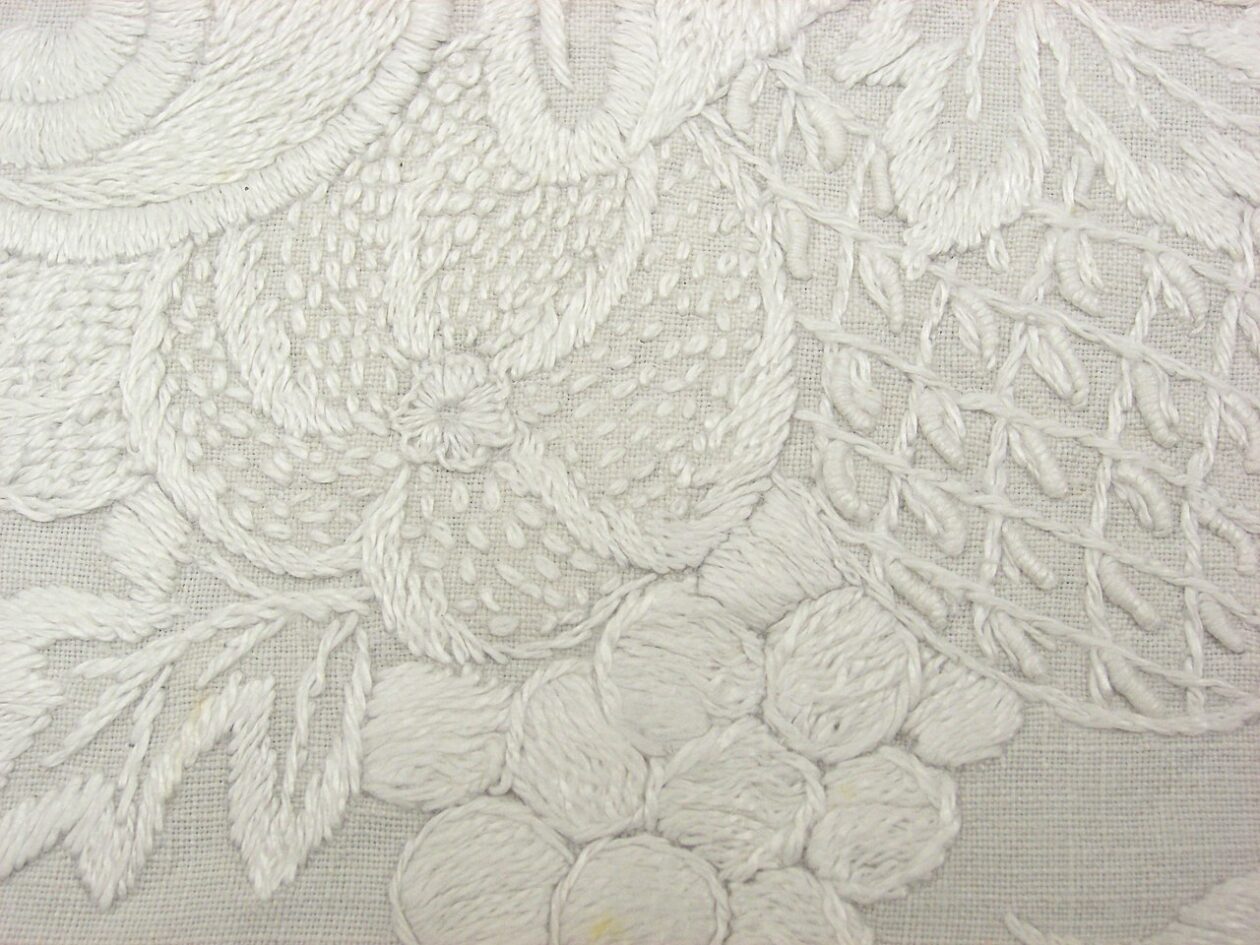
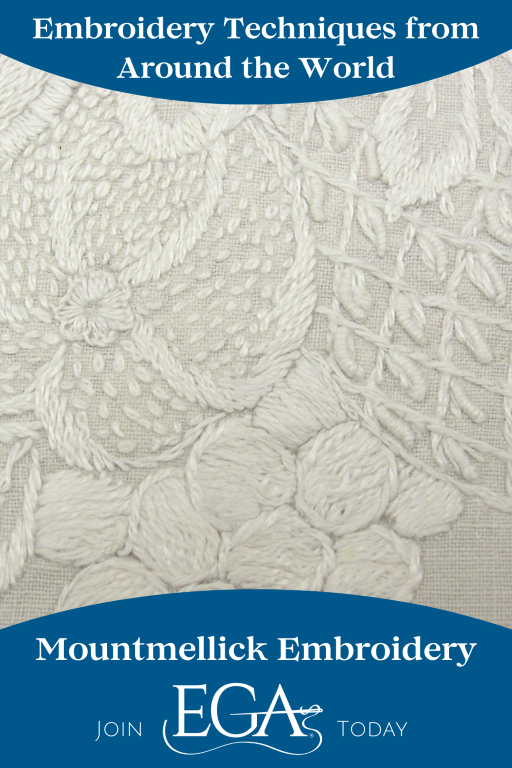
Materials, Techniques, and Stitches: Mountmellick embroidery is stitched with thick white cotton thread on heavy white cotton satin jean; both materials contributed to the durability of items embellished with Mountmellick embroidery. Despite being all white and used primarily for household linens, stained Mountmellick items could be boiled and cleaned easily without the items falling into disrepair. Although Mountmellick embroidery is sometimes referred to as Mountmellick lace, the style does not feature drawn or pulled thread or eyelets. It is a densely textured, raised style of embroidery that showcases knotted and padded stitches.
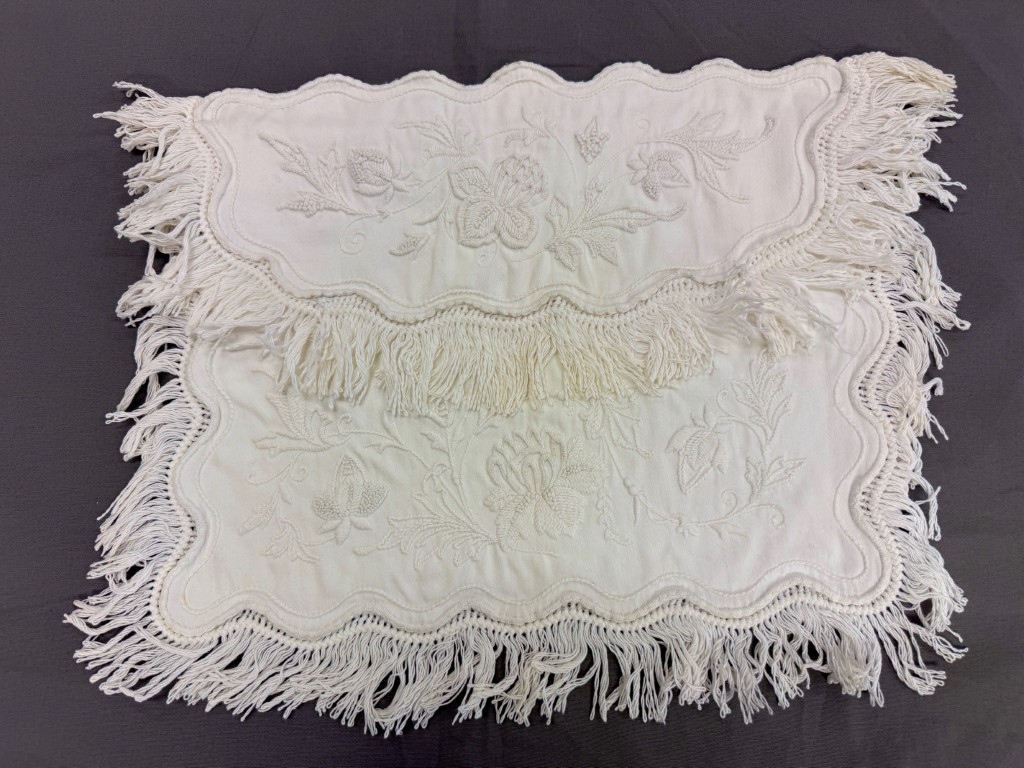
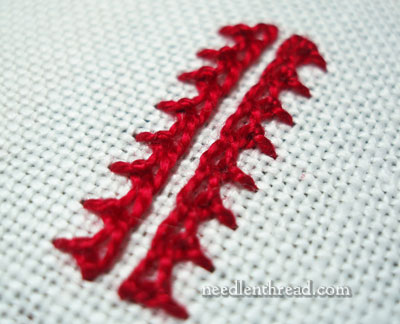
Mountmellick features stitches like stem stitch, cable stitch, coral stitch, chain stitch and detached chain stitch, back stitch, whipped back stitch, buttonhole stitch, feather stitch, bullion knots, blanket stitch, satin stitch, couched stitch, and French knots. Mountmellick stitch, which looks like a variation on chain stitch, is also used as an outline stitch.
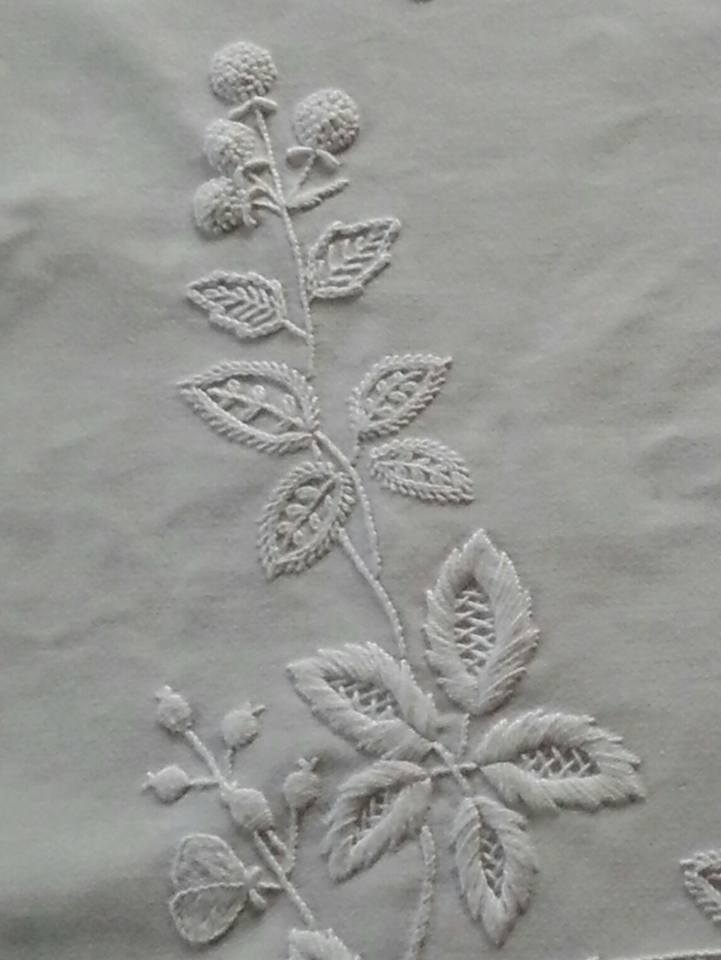
Motifs: The Irish countryside influenced the motifs featured in Mountmellick embroidery. Early Mountmellick embroidery showcased indigenous flowers and plants like brambles, blackberries, shamrocks, ferns, ivy, oak leaves, dog roses, and acorns. Later Mountmellick pieces included cultivated plants like snow drops, daffodils, tiger lilies, and cyclamens.
Sources:
Mountmellick embroidery. (2025, January 11). In Wikipedia. https://en.wikipedia.org/wiki/Mountmellick_embroidery
Mountmellick. (2026, January 23). In Wikipedia. https://en.wikipedia.org/wiki/Mountmellick
Textile Research Centre (n.d.). Mountmellick embroidery. TRC Leiden. Retrieved January 27, 2026, from https://trc-leiden.nl/trc-needles/regional-traditions/europe-and-north-america/embroideries/mountmellick-embroidery
(n.d.). Introduction to Mountmellick Embroidery. Blackwork Journey. Retrieved January 27, 2026, from https://www.blackworkjourney.co.uk/PDF/TQ0013%20Introduction%20To%20Mountmellick.pdf
(n.d.). Mountmellick embroidery has helped keep Ireland’s craft heritage alive for 200 years. The Irish Times. Retrieved January 27, 2026, from https://www.irishtimes.com/opinion/an-irish-diary/2025/10/27/how-mountmellick-embroidery-has-helped-keep-irelands-craft-heritage-alive-for-200-years/
Mountmellick Museum (n.d.). Mountmellick Embroidery. Retrieved January 27, 2026, from https://mountmellickmuseum.ie/history/mountmellick-embroidery/
(2006, August 8). Mountmellick Embroidery. Needle ‘n Thread. Retrieved January 27, 2026, from https://www.needlenthread.com/2006/08/mountmellick-embroidery.html
(2006, July 14). Video Tutorial: Mountmellick Stitch. Needle ‘n Thread. Retrieved January 27, 2026, from https://www.needlenthread.com/2008/07/video-tutorial-mountmellick-stitch.html