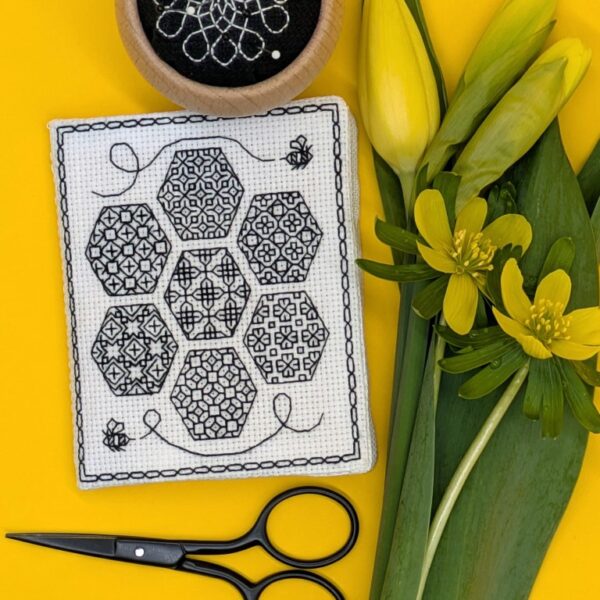
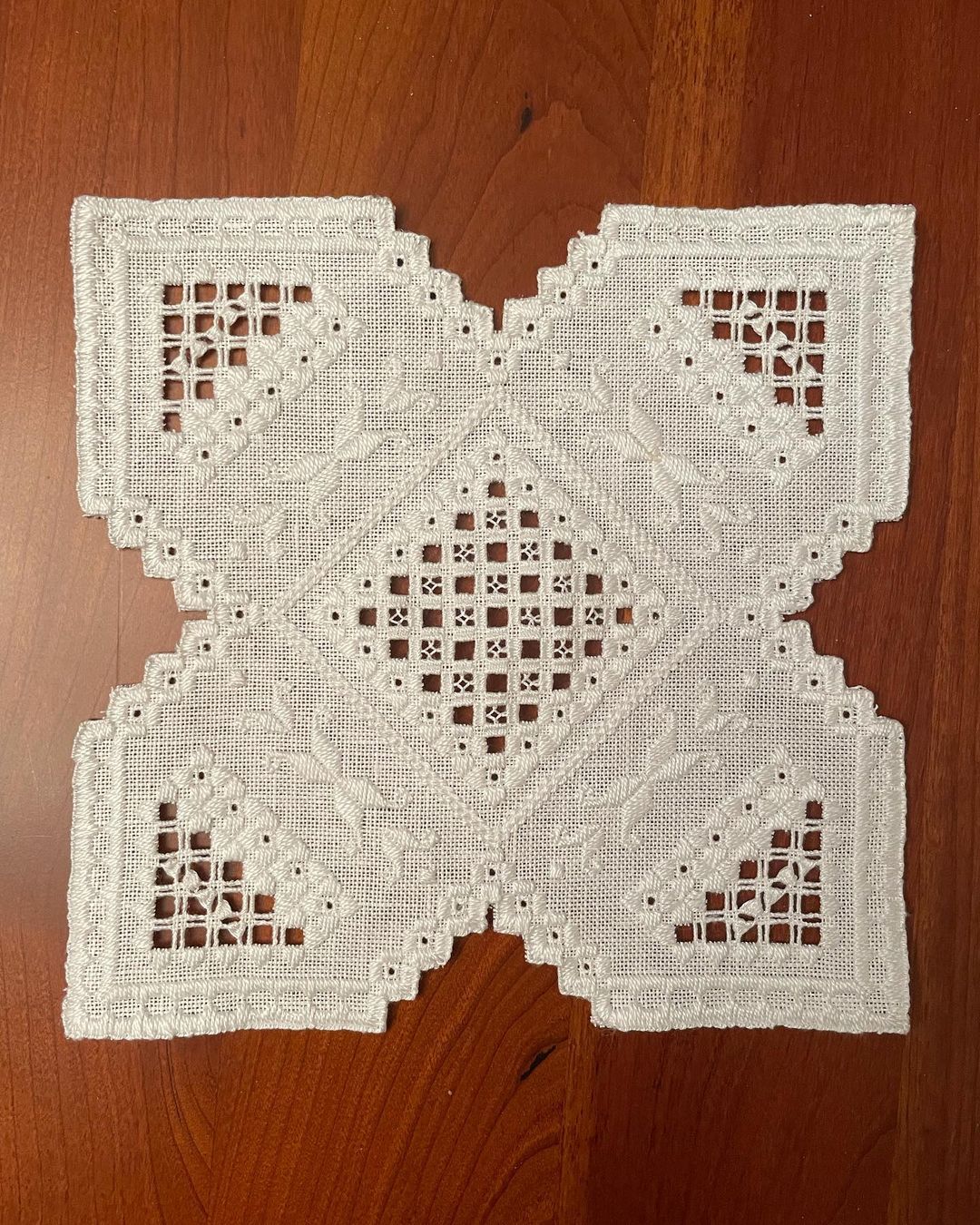
Canby Robertson has a long history with Crewel embroidery. She participated in EGA’s Master Craftsman Crewel Program during the early years of its incarnation, when the program’s technical requirements demanded rigorous attention to detail and exacting standards from participants. Despite the intensity of the program, Canby has been called “the most inventive and intense Master Craftsman in Crewel that the program has ever had.” We were excited to sit down with Canby to learn more about her experiences with Crewel, the Master Craftsman program, her teaching experiences, and more.
My first experiences with embroidery
To the dismay of my stitching grandmothers, as a child I had absolutely no interest in anything involving a needle and thread, no matter how often I was given the opportunity. I was happier being outside, wandering the woods and meadows, building dams in streams, climbing trees and jumping out of hay mows, being an all-round tomboy.
It wasn’t until the 1960’s when I was in college majoring in biology that I discovered the woven textiles of Annie Albers, Lenore Tawney, and other textile artists of the period. It hit me like a lightning bolt. I diverted from my major in biology and spent a year at RIT’s School for American Craftsman, majoring in Hand Weaving and Textile Design, with the intent of becoming a hand weaver.
The first year in the SAC program was a “survey year” in that we were exposed to many textile processes in 6-week segments. I learned batik, vegetable dying, printing (silk screen, wood cut, and lino block printing), Swedish rug making, hand weaving, and embroidery. The assignment for the embroidery pod was to construct a stitch dictionary. We were required to research individual foundation stitches and their variations, execute each of them in multiple fibers, and describe what our observations were. For whatever reason, I was hooked (Is that a pun?). Using multiple fibers, natural and synthetic, with each stitch, some fibers fine in size and some gross, to construct a dictionary, made the project interesting and challenging. I have often wondered if my attraction was due to the engineering mindset I have inherited from the long generational line of engineers in my natal family. Because, from that time, I have continued to be fascinated by the technical boundaries of working with individual threads. Why, under stress, thread does what it does and how I can exceed its normal capacity to make it go beyond.
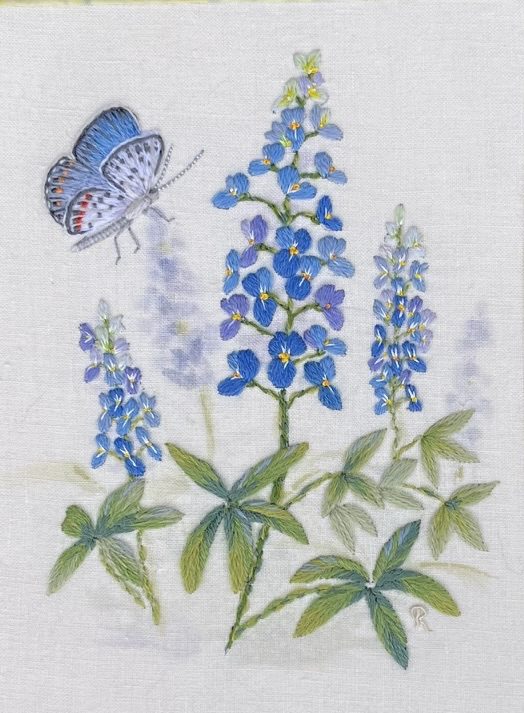
My journey with Crewel embroidery
Because of marriage, children, and job transfers, it took almost 20 years after my SAC year before my life allowed me the time to concentrate on becoming a proficient crewel embroiderer, my primary attraction. During the intervening 20 years my skills were not mature enough yet to design my own work, so I stitched on purchased kits, mostly by the designer, Elsa Williams, while waiting for the opportunity and time to concentrate on my love of crewel.
In the early 1980’s I was introduced to the work of crewel embroidery designer, Betsy Leiper, and was given the chance to work with one of Betsy’s trained teachers, Mildred Vandenburg in Wilmington, DE. Betsy’s style of crewel embroidery involved very dimensional applications of stitches, making the motifs rise off the surface of the ground fabric, at the time, very unusual and right up my alley of interest. Classes were held weekly, we had specific homework, and we worked hard to continue to be allowed to stay in the program.
Joining EGA
Although Betsy’s teaching program was independent and not affiliated with EGA, I decided to enlarge my own local embroidery community by joining the Brandywine Chapter of EGA at this time. Since my goal was to become completely fluent in crewel embroidery, the first 30 years of my EGA membership, I only took EGA classes that would improve my technical abilities in my preferred technique, very few in number.
Five years later, Mildred and her husband moved to Arizona and I was without a teacher whose detailed critiques I needed and valued to be able to continue to develop my own skill level. I decided to do my Master Craftsman certification in Crewel embroidery to access the desired criticism I needed. And, with a move to Baltimore in 1988, I discovered another “Betsy” teacher, Marj Jones, and began to study with her. And I changed my primary EGA chapter to the Constellation Chapter.
Taking the Master Craftsman Program in Crewel
At the time of the late 1980s and 1990s, to achieve a Master Craftsman Certification in any of the MC disciplines was difficult because the program was rigorous, far more rigorous than today. I don’t mean timewise, but the technical requirements were held to a very high standard. It took me more than 10 years to complete the six steps to receive my certification. In spite of my own years of preparation in crewel, if I remember correctly, of the six steps needed to be completed, I had only 2 passes with first submission, one complete fail that needed to be redone from the start, and the other remaining steps required correction and resubmission. It was hard and the critiques were demanding and exceptionally detailed. The anonymous judges of the MC program were early members of EGA and were highly respected in their teaching styles and accomplishments. In spite of the number of people who enrolled, very few people succeeded in completing the difficult certification requirements and to be awarded a certification was hard won and a thing of pride.
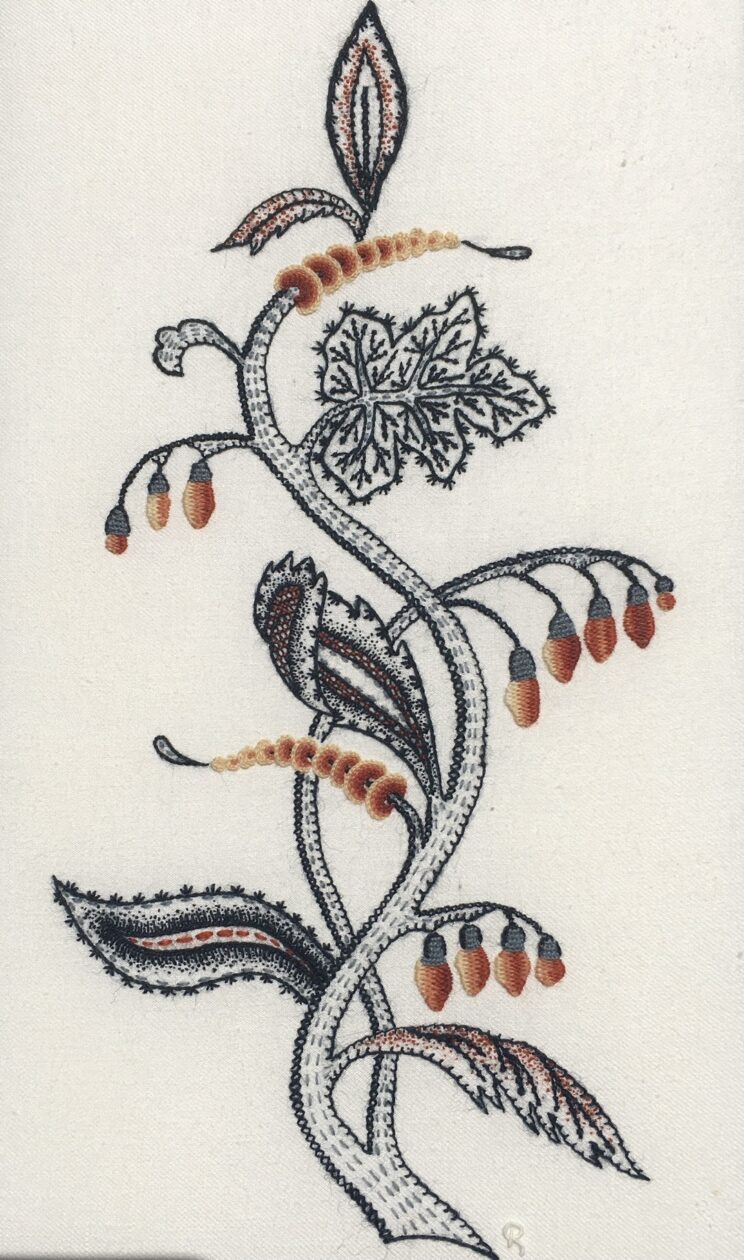
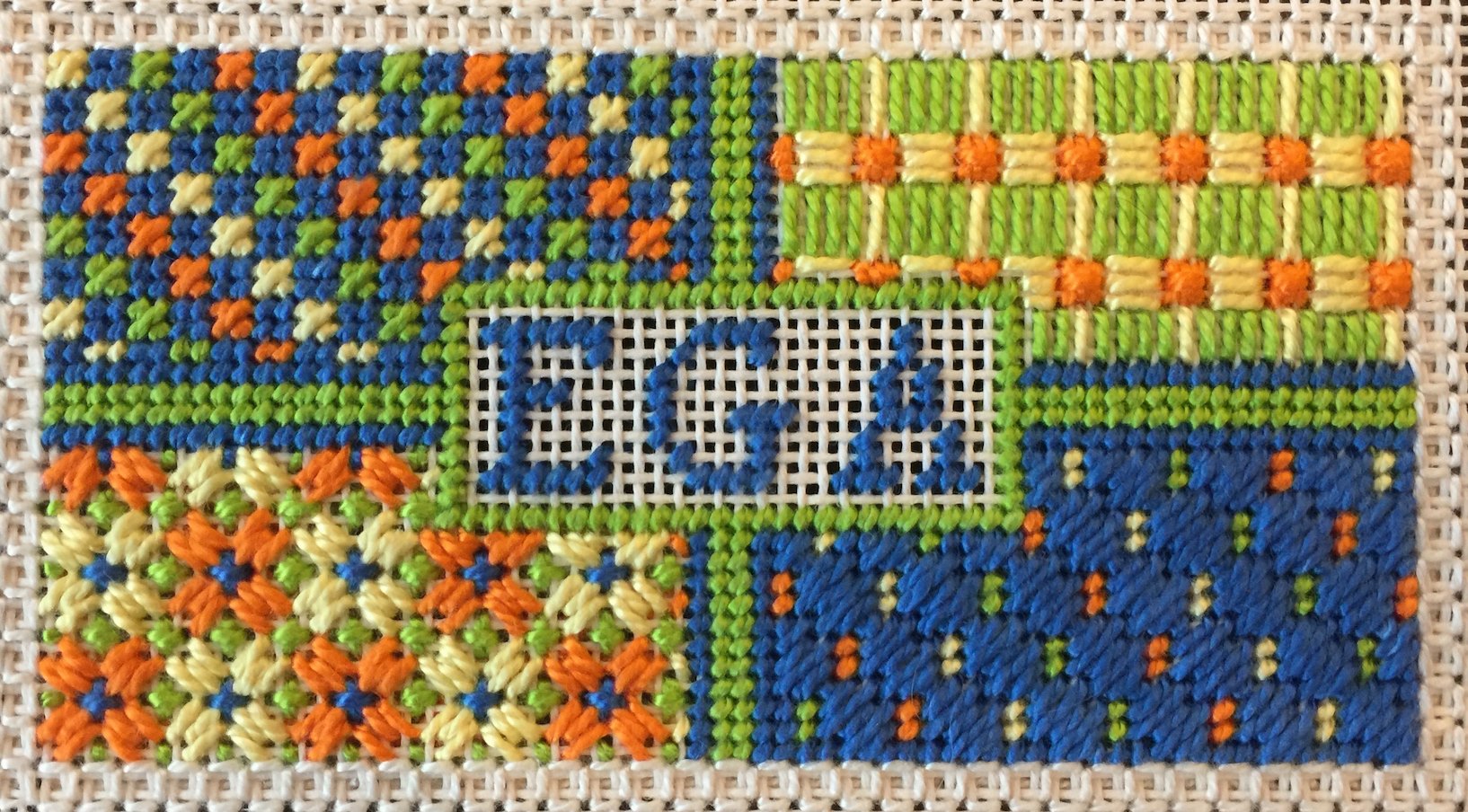
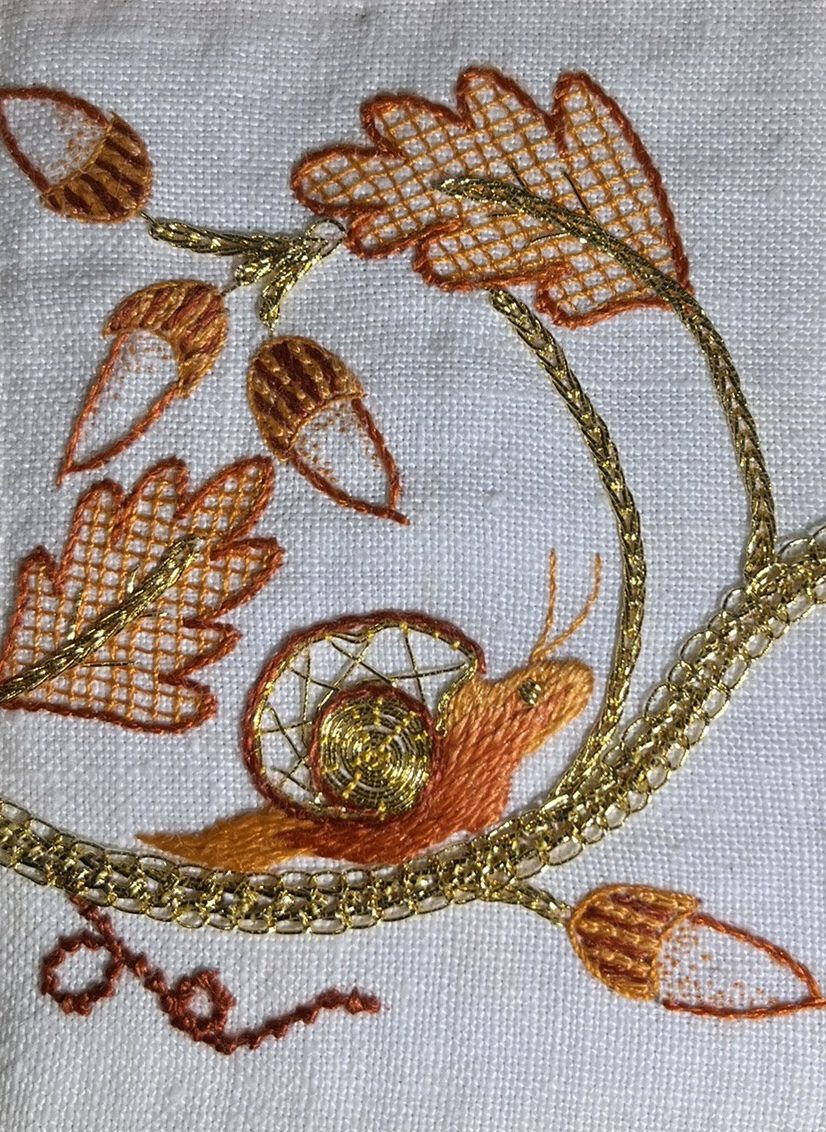
Design source: 18c English bed hangings
As an example of the rigor of the MC-C program, the critique I received with my “failed” first step submission thanked me for submitting, hoped I would resubmit in the future, and suggested I seek out an embroidery “technician” to study under before resubmitting a new piece in the future. Another conditional pass was refused because, when I blocked the piece, on one side I had pin holes at 1” intervals, not the ½” intervals required. No gold stars for my forehead and no holds barred! The suggestions were hard to hear, but so valuable over time. I took a year off before resubmitting my first step and studied under Pat Allen of Ridley Park, PA, a hard taskmaster and a perfectionist. A few years after receiving my certification, Pat went on to chair the MC-Crewel program for a short while in the early 2000’s but her standards were too high, and she was asked to resign midway through her term. My skills improved significantly doing the MC-C and I credit the expertise I have today to that first critique by the MC-C judges that forced me to become a student of Pat’s and have a year of her instruction. She was tough, very skilled at what she loved and a very good teacher, and today I credit her with much of my technical skills.
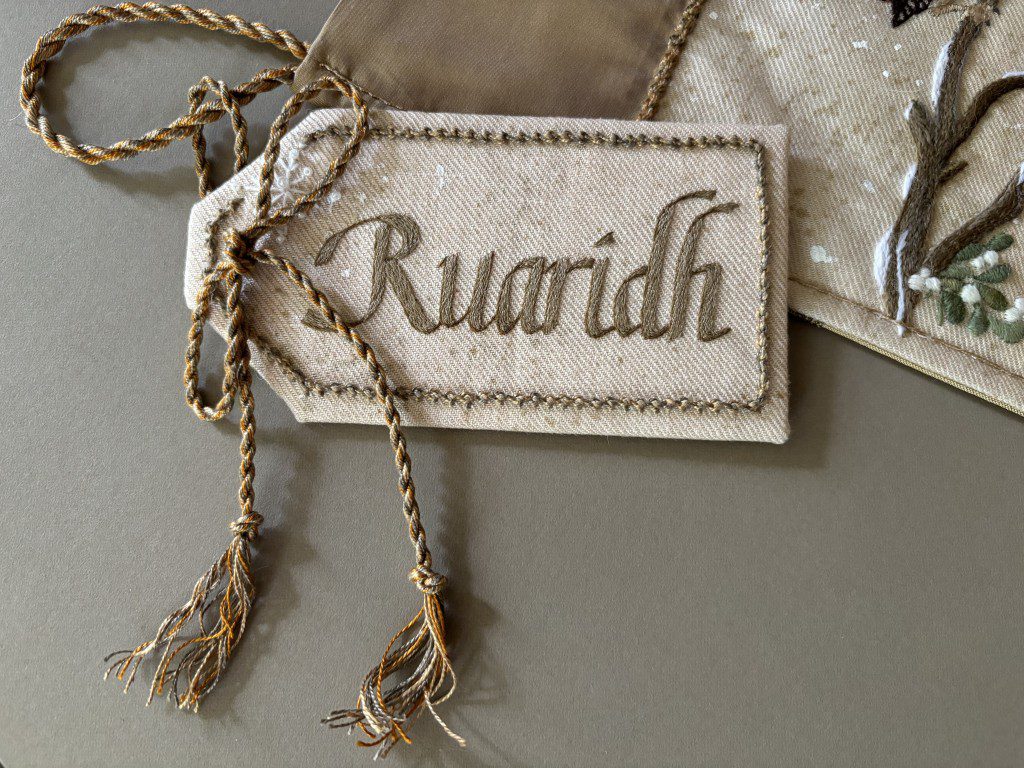
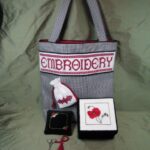
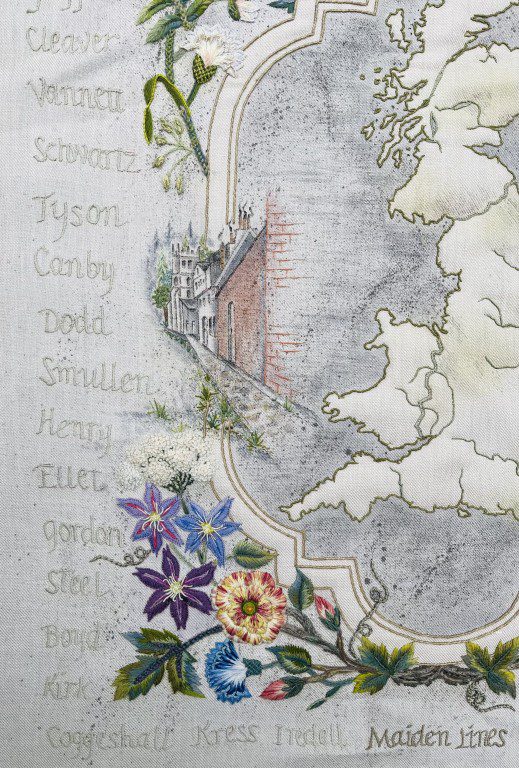
Note the surface embroidery lettering – stitched by Evelyn Stewart
A Return to Higher Education, and Rediscovered Passion for Crewel
My teaching activities came about organically. Historically, people seeing my work have asked me to share my knowledge, and so it begins.
I reached a bit of a wall in the early 1990s. A lot was going on in my life, and I was bored doing what I was doing with crewel embroidery, so decided to put my needle down and give up my interest in embroidery. I had reached the point where I felt I had successfully explored and reached a technical skill level in crewel that satisfied my curiosity. I was no longer excited about the designs available to me and I was ready to move on. I was in the middle of my MC-C program and I was determined to complete the certification process, but I wanted to go back to college to complete my degree in art and art history and the time was coming when that would be possible.
So, 2 years before going back, I decided to teach myself to paint by buying “how-to” books to give myself a head start toward the course requirements needed to receive my degree. By that time, after taking calligraphy lessons in the early ‘80’s I was teaching beginning calligraphy privately and at “adult evening ed” classes (remember those?) at our local high school in the Mid Atlantic. As with calligraphy, before much time passed, as I learned to paint, I was asked to teach decorative painting in my home for about 2 years before I went back to complete my degree.
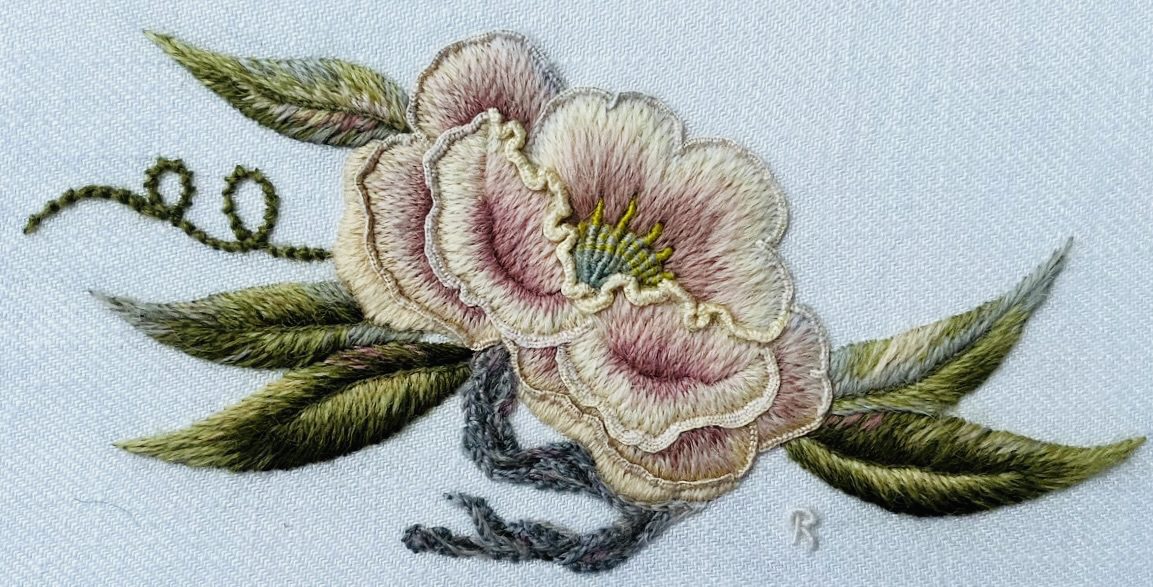
When I finally enrolled to complete my degree, I stopped teaching calligraphy and painting for lack of time, and my private classes ceased. As an adult returning to college with my own goals for my education, my professors gave me a great deal of latitude in satisfying course requirements. The first semester I was asked by the head of the art department, the question, “What was my specific goal for being in this program?” (Why was I returning?) He demanded that I be specific in my answers about each of my creative pursuits and those answers ended up defined the remainder of my whole course of study. After some thought, I realized that my answer was “integration!” I had principle, but separate creative pursuits. How could I integrate them to their benefit and mine? The journey was creatively enlarging with the added major of art history, and it took 5 years before I graduated in 1998.
My education allowed me to realize a solution to my boredom with crewel embroidery. I needed to activate the ground fabric and the embroidery together for an integrated design to interest me. So, I started painting on fabric to construct an environment in which my embroidery could exist. And, at times I added lettering, mostly as tone-on-tone in machine embroidery texture in backgrounds.
And, today, for my own work, the integration of all three—embroidery, calligraphy, and painting—leads to a more satisfying result that keeps me engaged.
My Experiences With Teaching
Marj Jones died in the early 2000’s. I was a student in one of 3 private classes she taught at the time of her death and two of the classes asked me to take over for her. That began my years of teaching embroidery. In my early years I only taught privately, not for EGA. My design work was limited to my own work, not for students. Following Marj’s death, I was juried into EGA’s Fiber Forum. I attended FF’s annual retreat/workshops for a number of years and, during one workshop, I used a flat brush to paint names in calligraphic style on some of the aprons being worn by members at the retreat. Shortly after, when Judy Jeroy, also a member of FF, chaired the EGA National Tapestry project, she called me on the phone and asked if I could design the lettering for the stanzas of “Oh Beautiful for Spacious Skies,” for the tapestry.
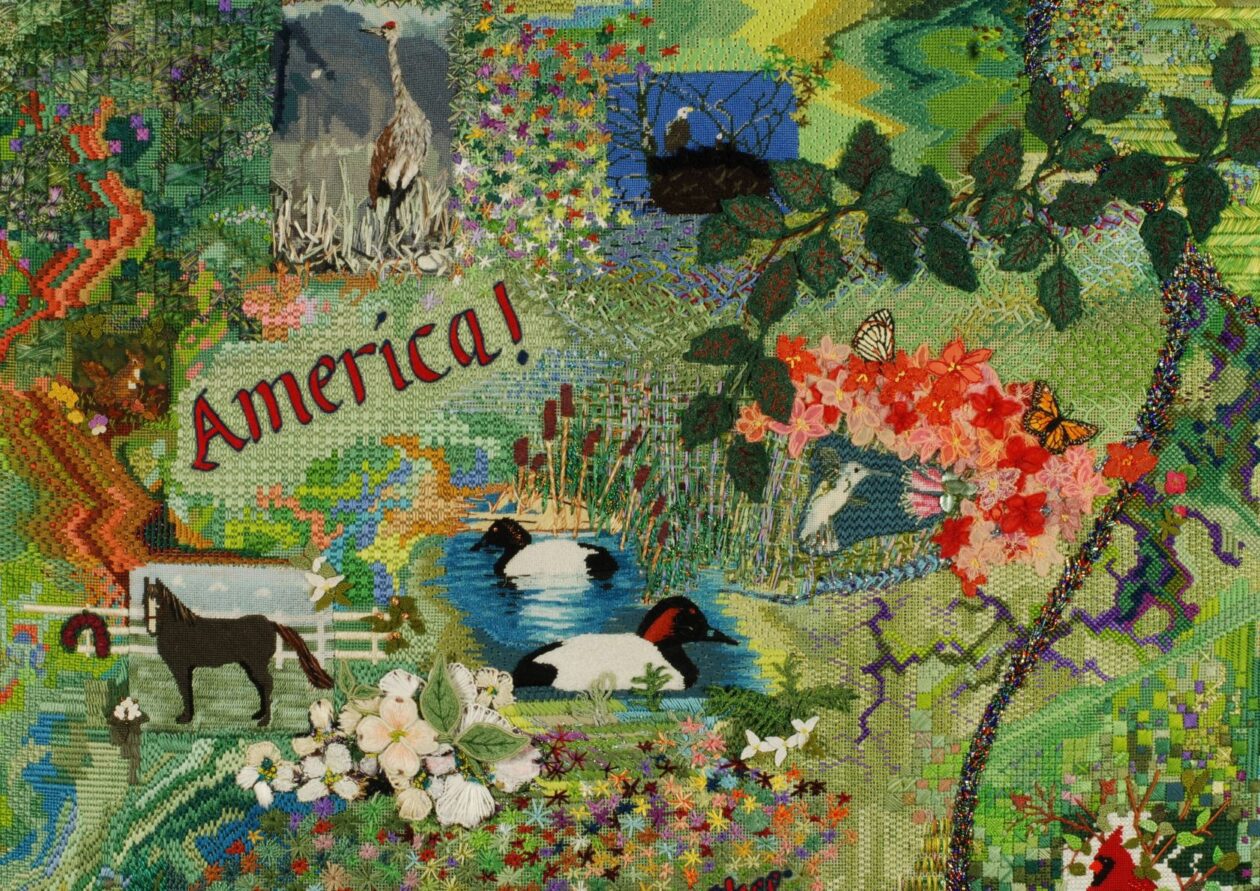
In the mid 2000’s, Marie Campbell chaired the EGA National Seminar in Richmond, VA, and Judy was the faculty chair. Again, I thank Judy for calling me on the phone with specific requests that I teach 3 classes in my area of interests including a one-day class on lettering. It was my first EGA national seminar and the first time I taught lettering for surface embroidery. And teaching and designing have evolved from there.
On Designing
What do I think about when I design a new piece? I am very visual, so a new design is always a result of something I have seen that sparks a creative response. My design work cannot happen without this visual input. But, unless it is a specific piece I intend only for my own work, I am always thinking about how it can be presented as a class, either as a learning opportunity about the history of the surface embroidery techniques that I am personally attracted to, or as an environmental discussion relevant to today’s climate issues. It seems that my childhood years growing up outside wandering the meadows and streams has never left me.
My process is simple once an idea forms. My inspirations come from many sources; natural plants and animals, insects, books I have read, books with beautiful visuals, collections in museums, greeting card imagery, illustrations and photographs, once I even had a design inspiration from a paper cocktail napkin. Sometimes a design takes years to perk, sometimes far less.
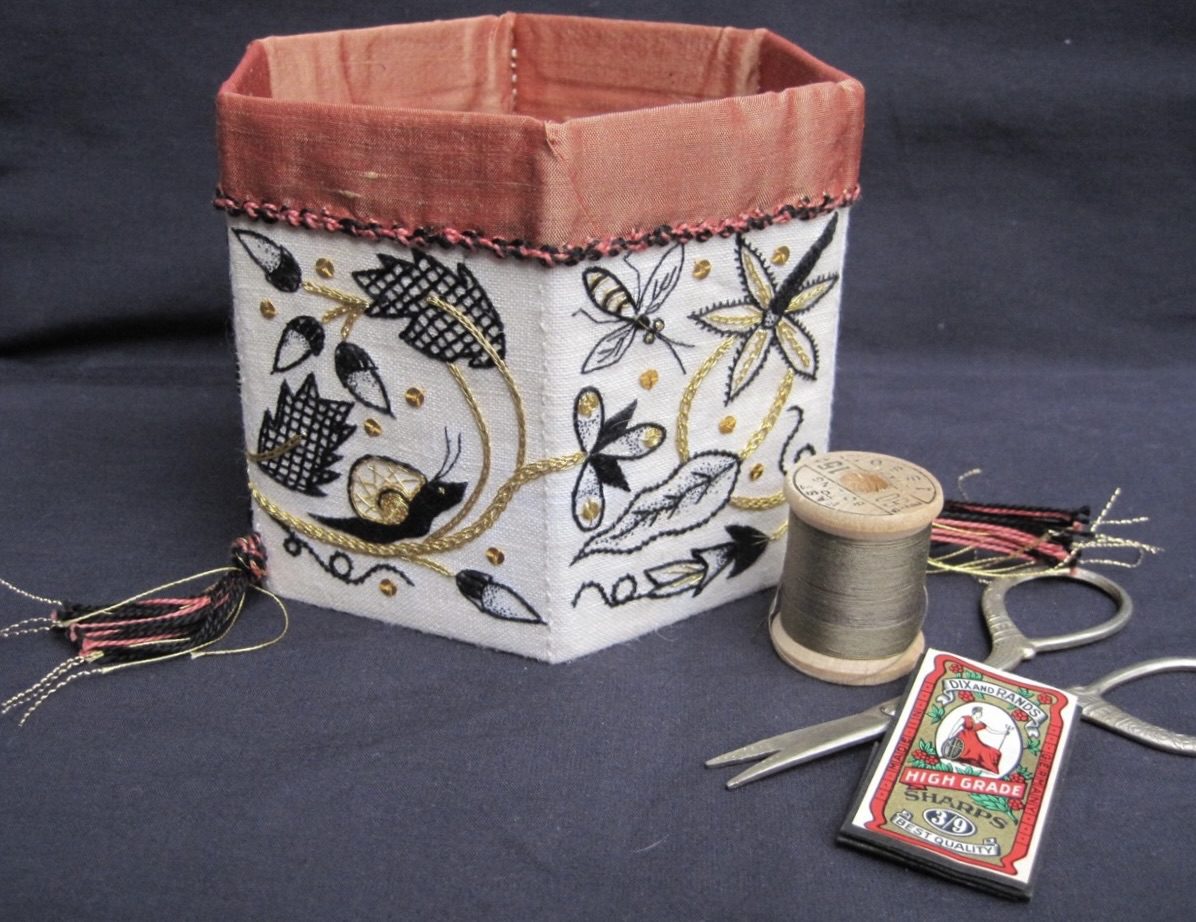
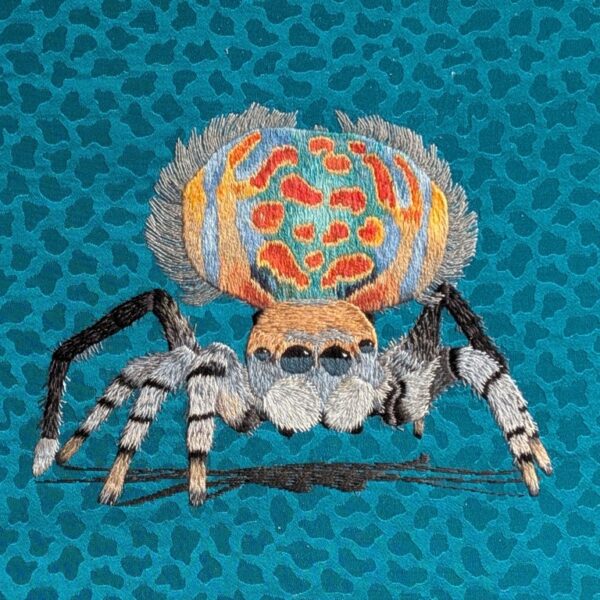
I am attracted to historic examples of periods of English surface embroidery like Late Period Blackwork, not only for the design work but because of the economic, political, and scientific conditions of the time that allowed it to evolve. At the beginning of a design idea, I research on the internet. For historic inspiration, the Victoria and Albert Museum in London has digitized their embroidery holdings, including many pieces of the techniques I am interested in. The Late Period Blackwork orts boxes I have designed have been influenced by examples in their collections. Museum of Fine Arts in Boston, The Henry Francis DuPont Winterthur Museum in Delaware, and the Met in NYC are three other museums with collections holding wonderful inspiration.
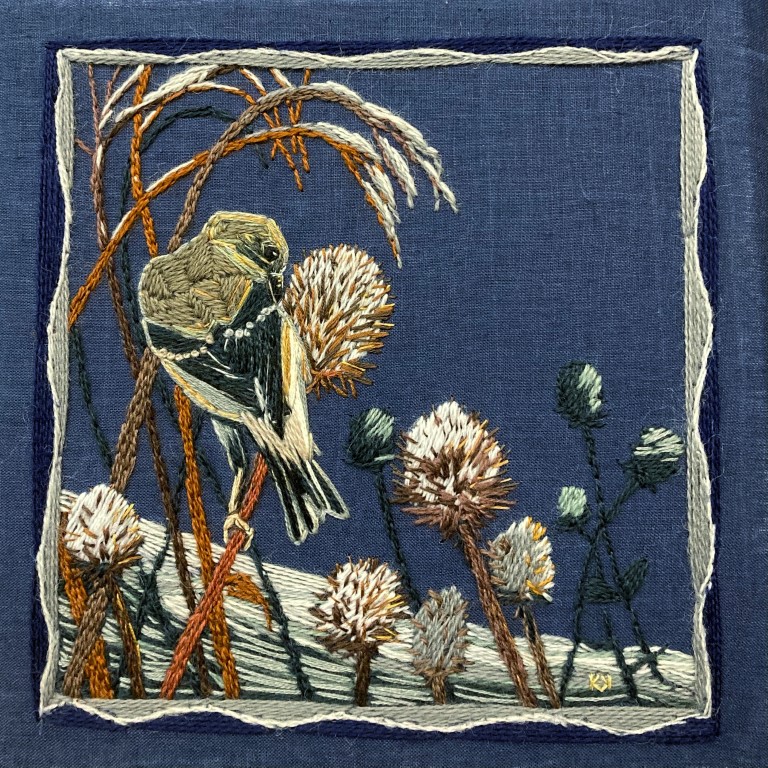
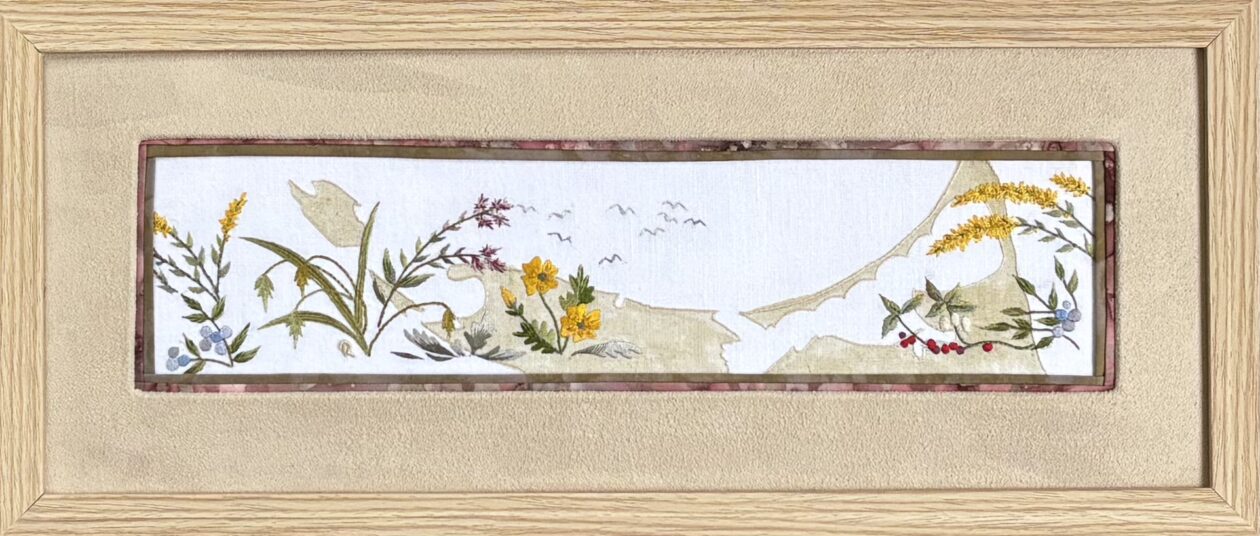
If a new design has an environment theme, I am drawn to landscape design. An environmental piece is always designed to the location of the seminar event. The Dickcissel’s Prairie Box design was designed for a national seminar in St Louis, near the Virgin Prairie Park Lands. Rufa Red Knot evolved to speak to environmental issues in the Mid-Atlantic and New England coast lines for a seminar that took place in the Atlantic coast city of Boston. This summer I will teach a design on Nantucket Island of wildflowers native to the island with a painted outline of the island behind the embroidery. Again, once the seed of an idea happens and I know the location of the seminar, I go on the internet and research themes, images, and issues to find images that interest me relating to the location, if I decide on a landscape.
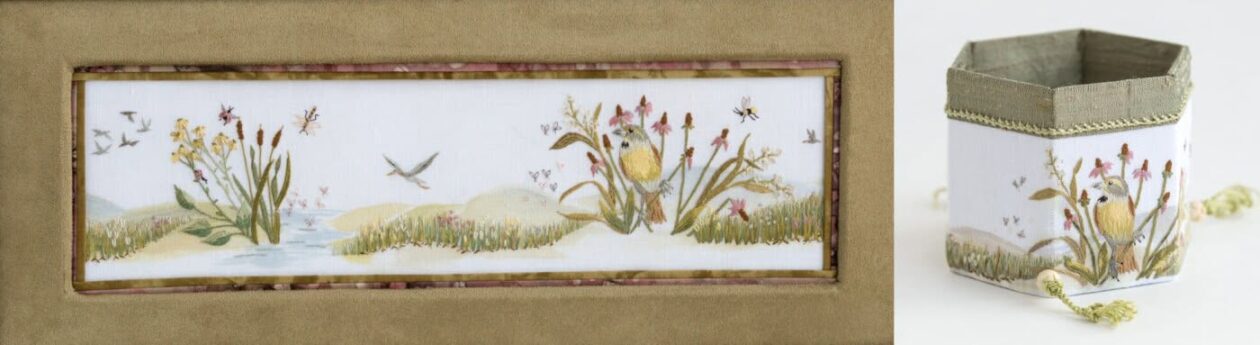
My Design Process
My designs and kits are complicated because of my iterative process. I work my initial design on architect’s vellum in pencil. Once the design is fine-tuned, I copy it in permanent ink. That becomes the pattern for transfer using a light box. Once it is transferred to the ground fabric, I paint the background if the design requires it. Then I stitch it, making note of color selection and amount of thread used for each element in the design, keeping detailed notes of stitch selection and other details for my materials list. Once the initial embroidery is complete, I assess. Designs on paper are never the same once stitched. Are things in balance? Do I need to refine, enlarge, reduce, or change certain elements in the design? There are always changes of one sort or another so I then stitch it a second time. Then, about 18 months before an event, I put together a proposal and submit it for consideration.
If the class is picked up for a seminar, I write the first draft of the directions and look for pilot stitchers. When their critiques are returned to me, I edit the directions, fine tune my materials list and place my materials order about 3 to 4 months before seminar happens. If I am lucky and receive my materials without glitches in delivery due to tariffs, I can kit once I have a preliminary class count. And, because of my design interests, kitting is time consuming.
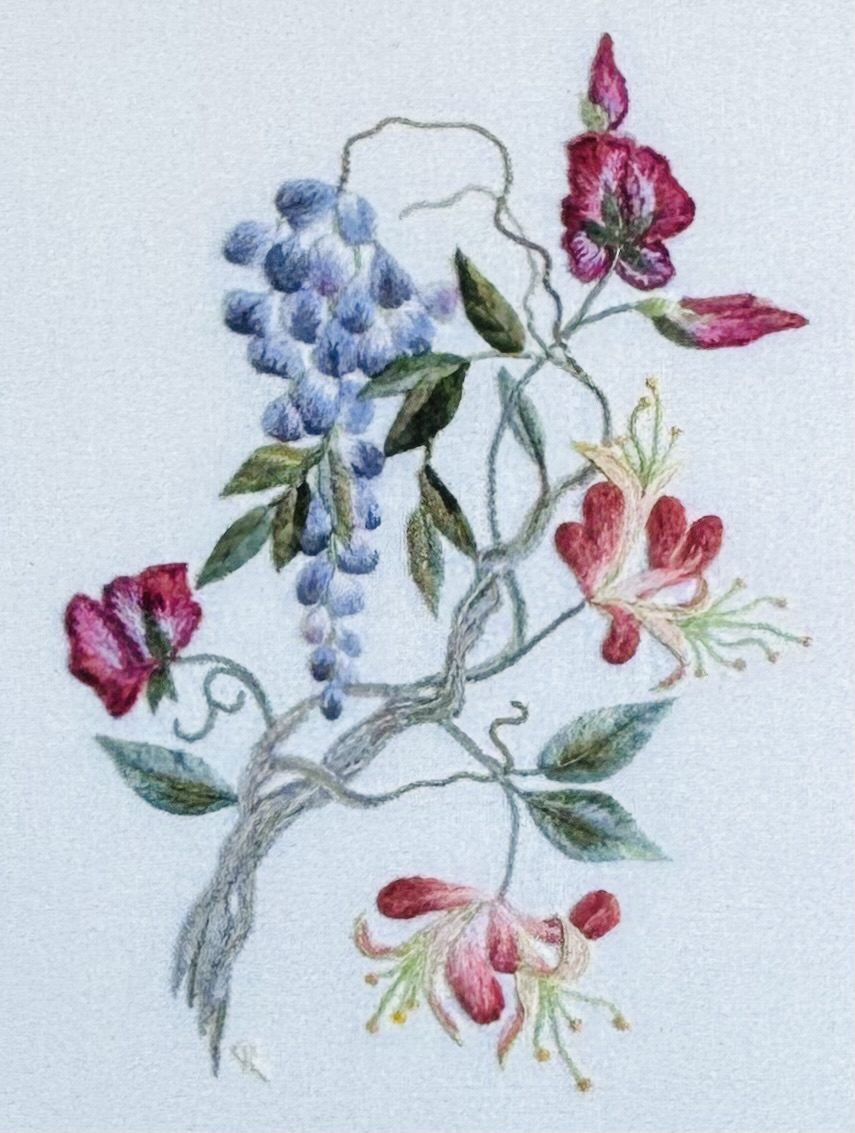
Design inspiration: cocktail napkin
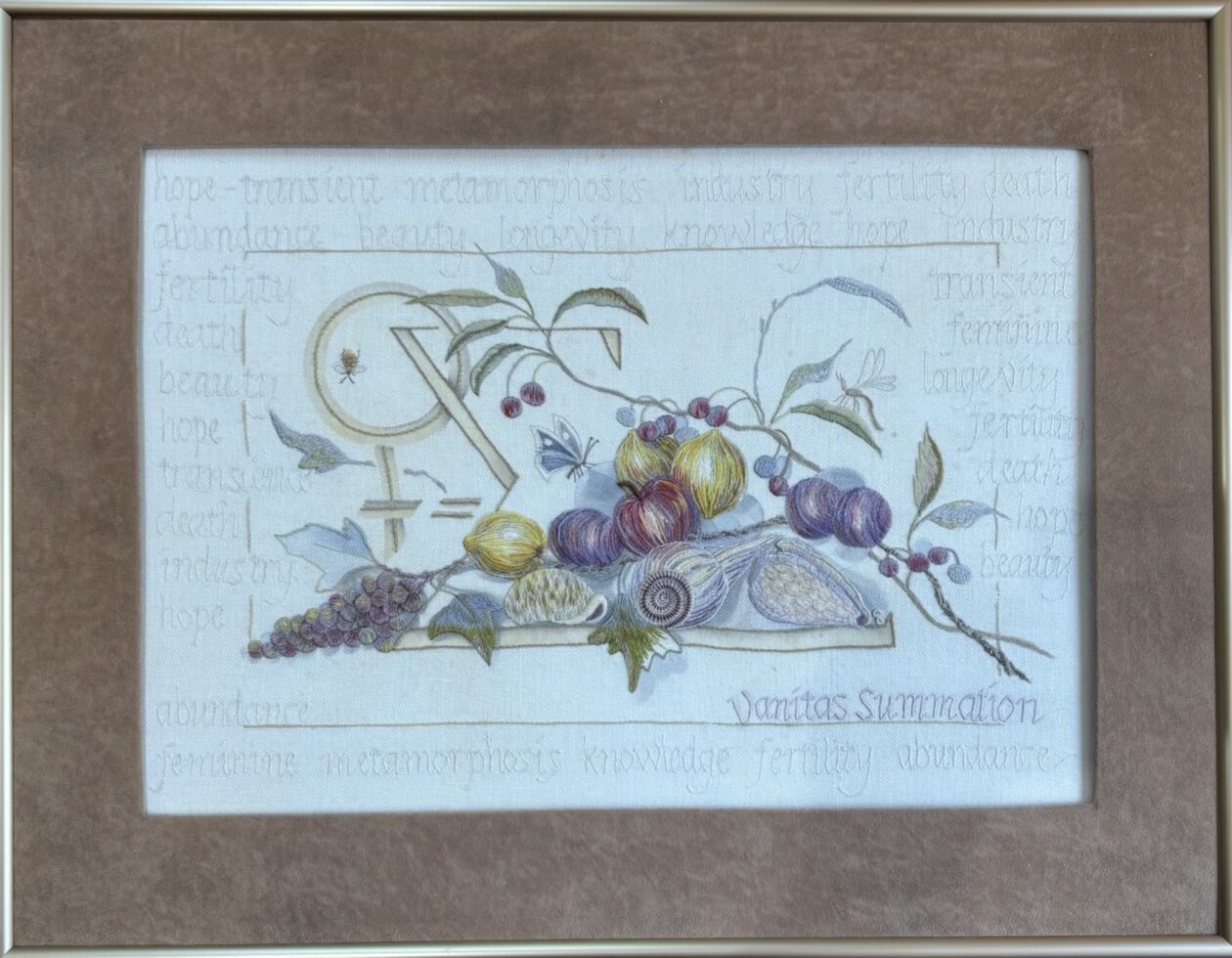
What is my favorite design? I view each piece as a logistical challenge. My favorite is the last thing I stitched, because that was my most recent creative challenge and it sits in my brain for a long time afterward as I mull over the plusses and minuses. If I could only take one or two pieces with me as I exit life, Vanitas Summation would be one. It was the first piece I designed in 1998 after I completed my degree and receiving my MC-C certification. It is crewel embroidery on linen twill with painted elements. The design is set up like a mathematical equation, combining my husband’s interest in statistics and my interest in art history and women’s issues.
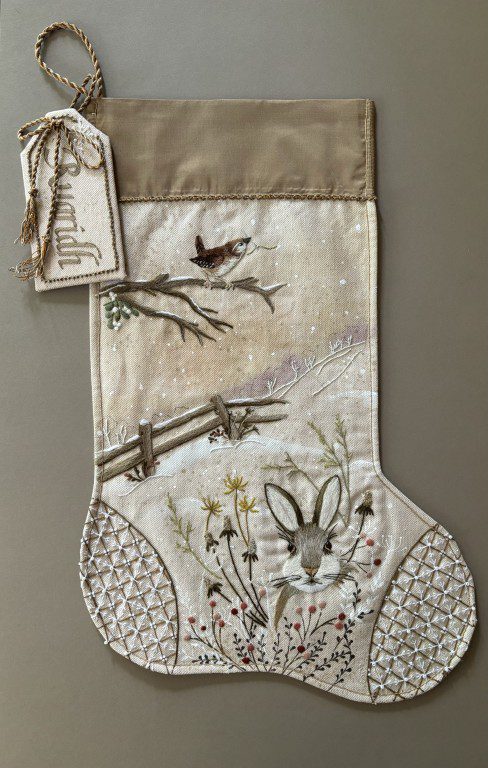
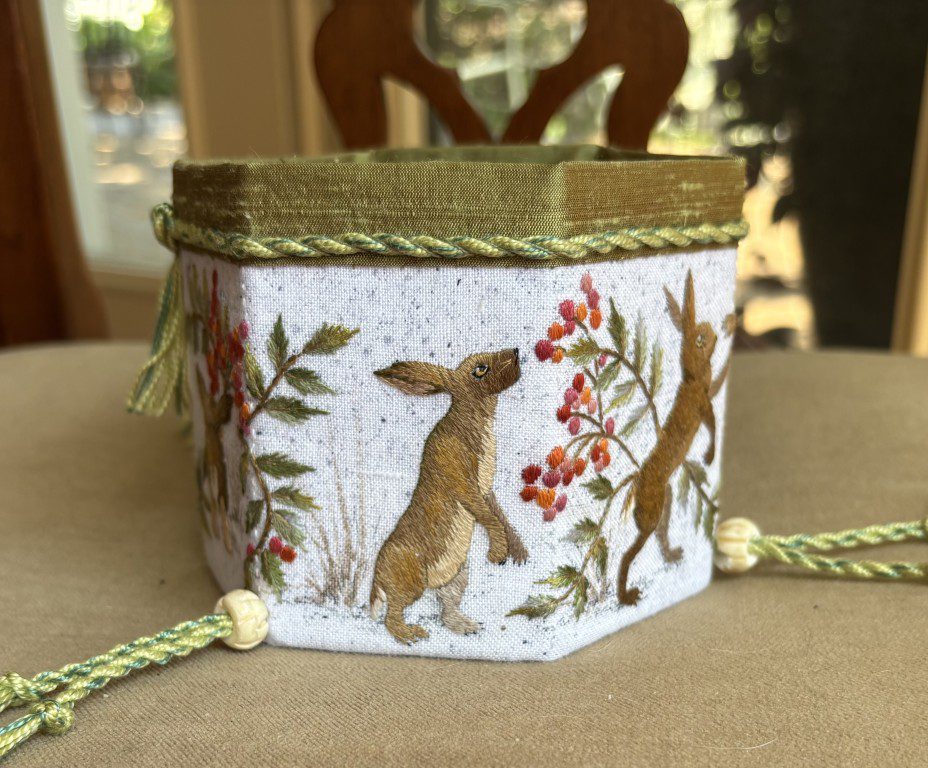
Do I ever design anything the does not become a class after all of that effort? Yes! Last year, I decided to offer a new orts box using the theme of Scottish hares and rowanberries. The intent of the class was to offer an advanced soft shading technique class using silk threads. I love the design, 6 hares in different positions on a paint spattered background, with overarching rowanberries and branches, and painted grasses integrating the ground with the embroidery. As the process is described above, I stitched it twice. But, in the end I decided that I could not teach it because it was too advanced and I could not, in a 2-day class, adequately help students sufficiently who had not appropriately registered for the degree of difficulty and were not skill ready. It was also not financially attractive to offer it in a longer class format.
Advice for Embroiderers
To close, what can I offer as a bit of reflection? I feel that the practice of learning embroidery is like learning a new language, no different than learning French, Spanish, or Latin in high school. It is meant to be a means of expression. So, now that we have spent years mastering this new language, what do we as individuals wish to say about ourselves and the life we live? Most of us are skilled enough to copy the teacher’s class model. And when we are done, we have a beautiful copy of the teacher’s work, that all. How can we personalize? I recognize that not all of us have design skills, but we can make individual decisions about personalizing any piece we are working on. We can change colors, add beads or metal thread, change stitch choices. Add a name or saying. We can make it our own. It then becomes a statement about us as individuals and that is wonderful.
I do not have the time, energy, or interest for websites or social media. But I do answer email inquiries at canbyrobertson@gmail.com.