Technique: Kantha
Place of Origin: Bangladesh and India
Earliest known date: 1500 BCE
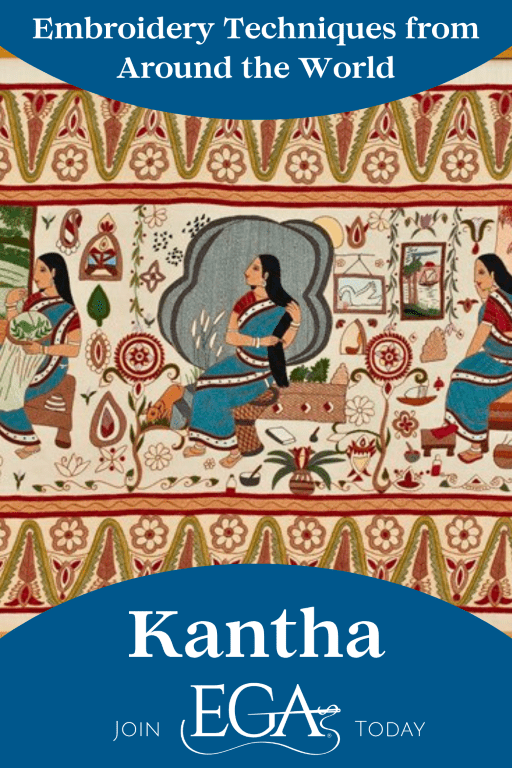
History: Kantha embroidery is one of the oldest forms of embroidery to come out of South Asia, dating back over a thousand years to the pre-Vedic age, approximately 1500 BCE. Kantha originated in Bangladesh and areas of eastern India among rural women, who passed down the folk art technique from mother to daughter.
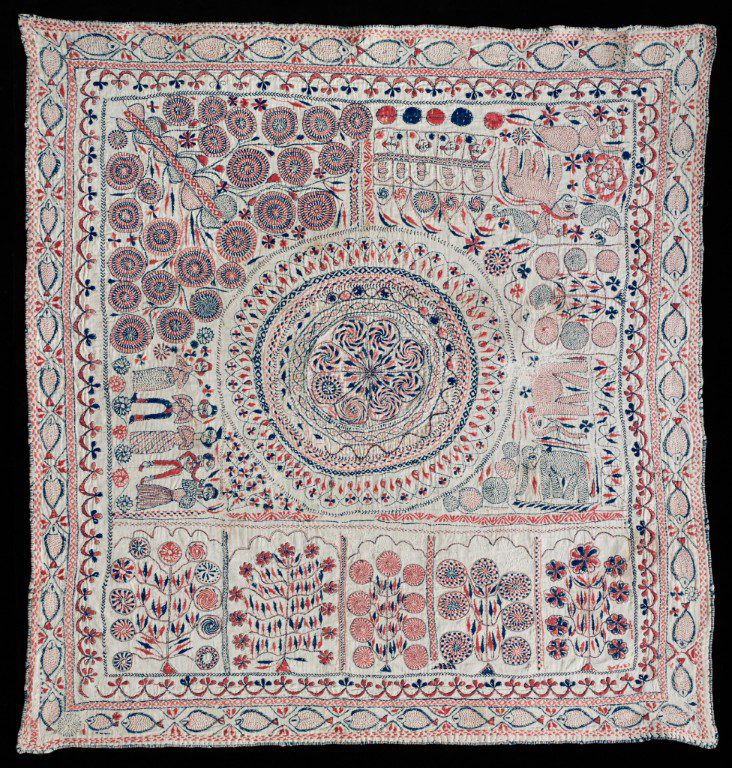
The word “kantha” has unknown etymological origins, although it has a few potential sources: ‘kheta’ in Bengali means ‘field,’ and ‘kontha’ in Sanskrit means ‘rags’ as well as ‘throat.’ The Sanskrit translation provides clues as to how Bengali women used Kantha embroidery: as a storytelling device to capture the embroiderer’s voice, express feelings, record family and life stories, and share the religious and spiritual mythologies of Hinduism.
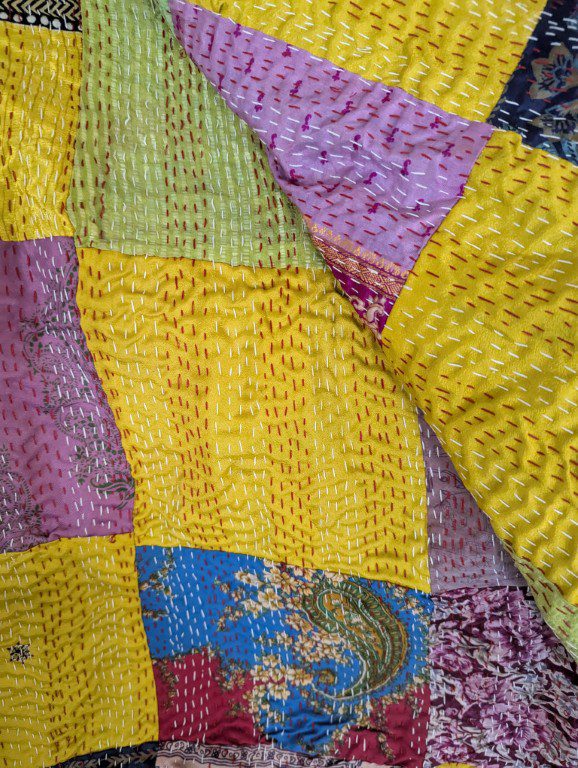
Kantha is much like the Japanese art of Boro; both arose out of a need to use and reuse precious textiles, layering multiple fabrics with visible mending techniques to create a stronger, more durable fabric. Kantha fabrics featured throughout the Bengali home: swaddled around babies, draped over beds, as prayer mats, pillowcases, and bags, and gifted as quilts in wedding dowries.
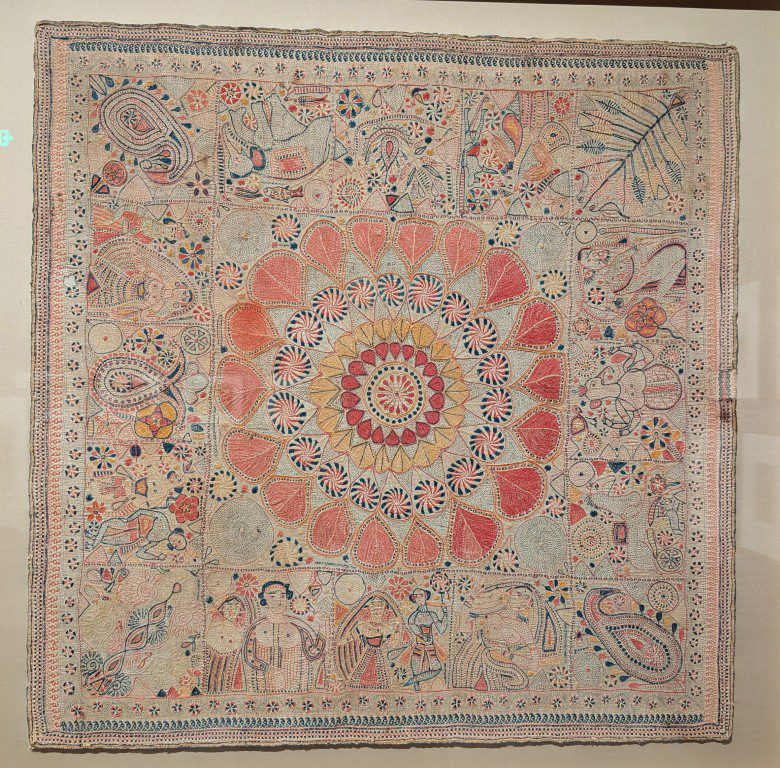
Materials: Kantha cloth exhibited upcycling at its best. Embroiderers reused old cotton saris, lungis, and dhotis—the traditional wardrobe of South Asian women and men—to create Kantha embroideries. Often, the thread was pulled out of the old clothing and reused to stitch the Kanthas! Today, a coarse thread is used to stitch Kantha, and as few as 2 or as many as 7 layers of cloth may be used.
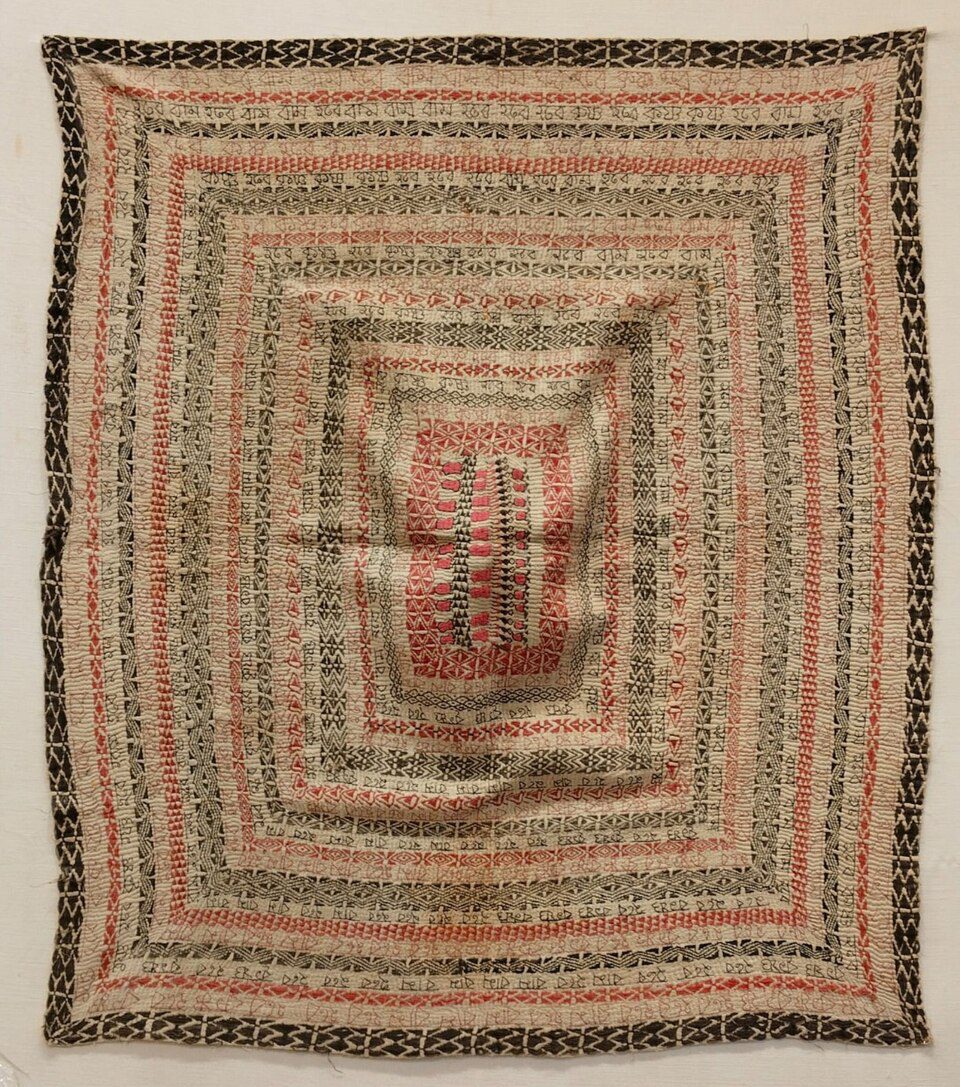
Techniques and Stitches: Artisans craft kantha by layering several pieces of fabric, often 5 or more pieces of cloth. Layers of cloth are basted together before the stitching begins. The running stitch is the most common and earliest stitch seen in Kantha. The running stitch gives Kantha fabrics a rippled texture, and is used as an embroidery and quilting technique to combine the fabrics, instead of other quilting techniques like patchwork and applique. Kantha running stitch is also known as ‘kantha phor,’ and is used to both outline and fill in designs. Other stitches, related to surface embroidery stitches and serving as variations of running stitch, also feature in Kantha:
- Chatai phor – resembling and named after a woven grass mat (chatai), the Chatai phor is like satin stitch, with parallel running stitches placed close together.
- Kaitya phor – similar to Chatai phor, except stitches are staggered slightly ahead or behind the previous row to create a swirling effect.
- Lik phor – a double running stitch, like Holbein stitch.
- Lohori phor – running stitch applied in a wavering design.
- Bhorat phor – Like couching, a long stitch is held down in the middle by a shorter stitch.
- Bakhiya phor – Back stitch, used in outlining.
- Dal phor – Stem stitch, also used in outlining.
Chain stitch, blanket stitch, herringbone stitch, and cross stitch also feature in modern Kantha designs.
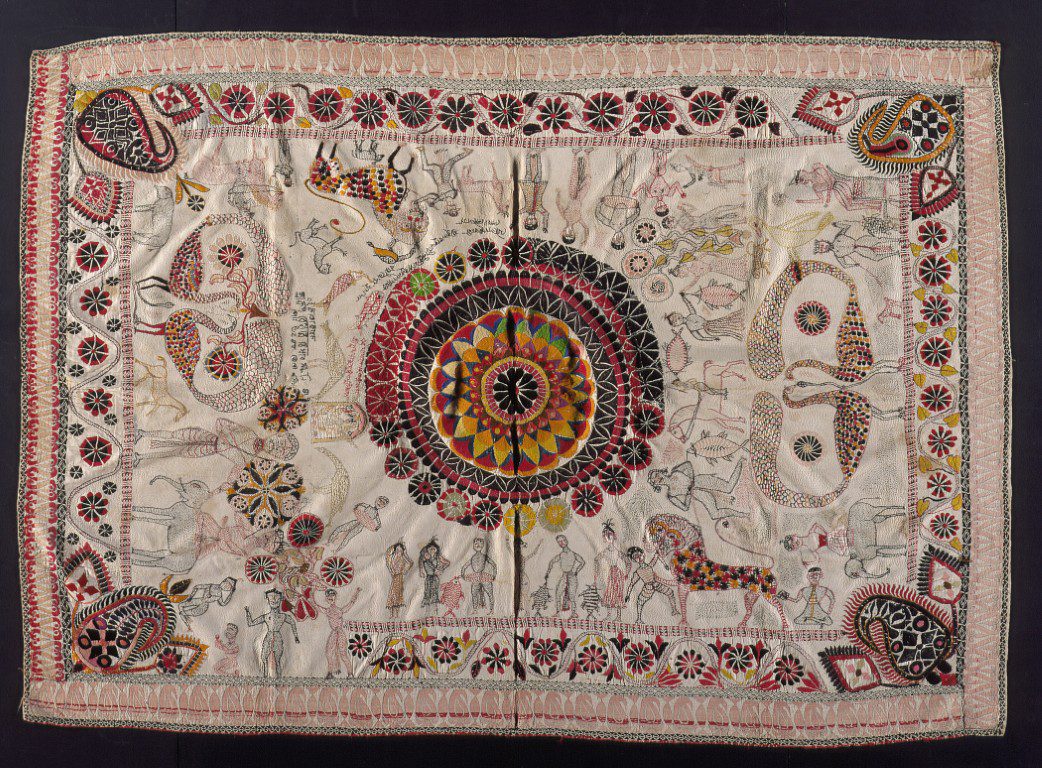
Kantha exists in various styls defined by different factors: how the technique has evolved across time, the different regions of Bangladesh and India from which various techniques arose, and cultural influences.
- Sunji Kantha – found in the Rajshahi region of Bangladesh, featuring floral adn vine motifs
- Cross stitch Kantha – arose under British occupation of India, featuring cross stitch motifs
- Nakshi Kantha – less defined by region, and more the evolution of Kantha to include more artistic designs to create embroidered quilts, where complex designs were first outlined with needle and thread before worked
- Par tola Kantha – Done without a drawn pattern and worked from memory instead, showcasing simple and complex geometric patterns
- Lik or Anaransi (pineapple) Kantha – from the Chapainawabgonj and Jessore areas of northern Bangladesh
- Lohori (wave) Kantha – from the Rajshahi region, and divided into 3 types: soja (straight or simple), kautar khupi (‘pigeon coop’ or triangle), and borfi (‘diamond’) forms.
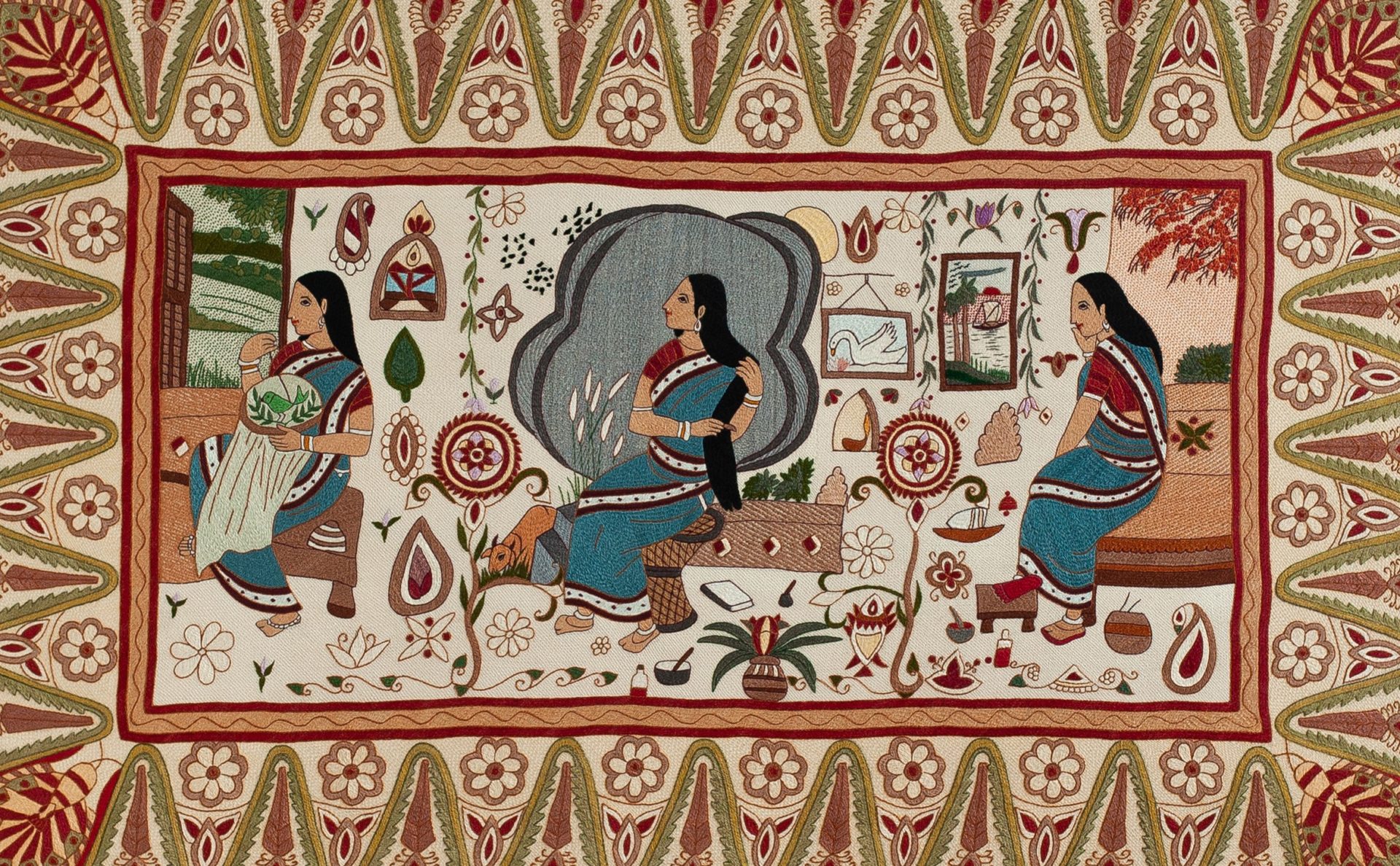
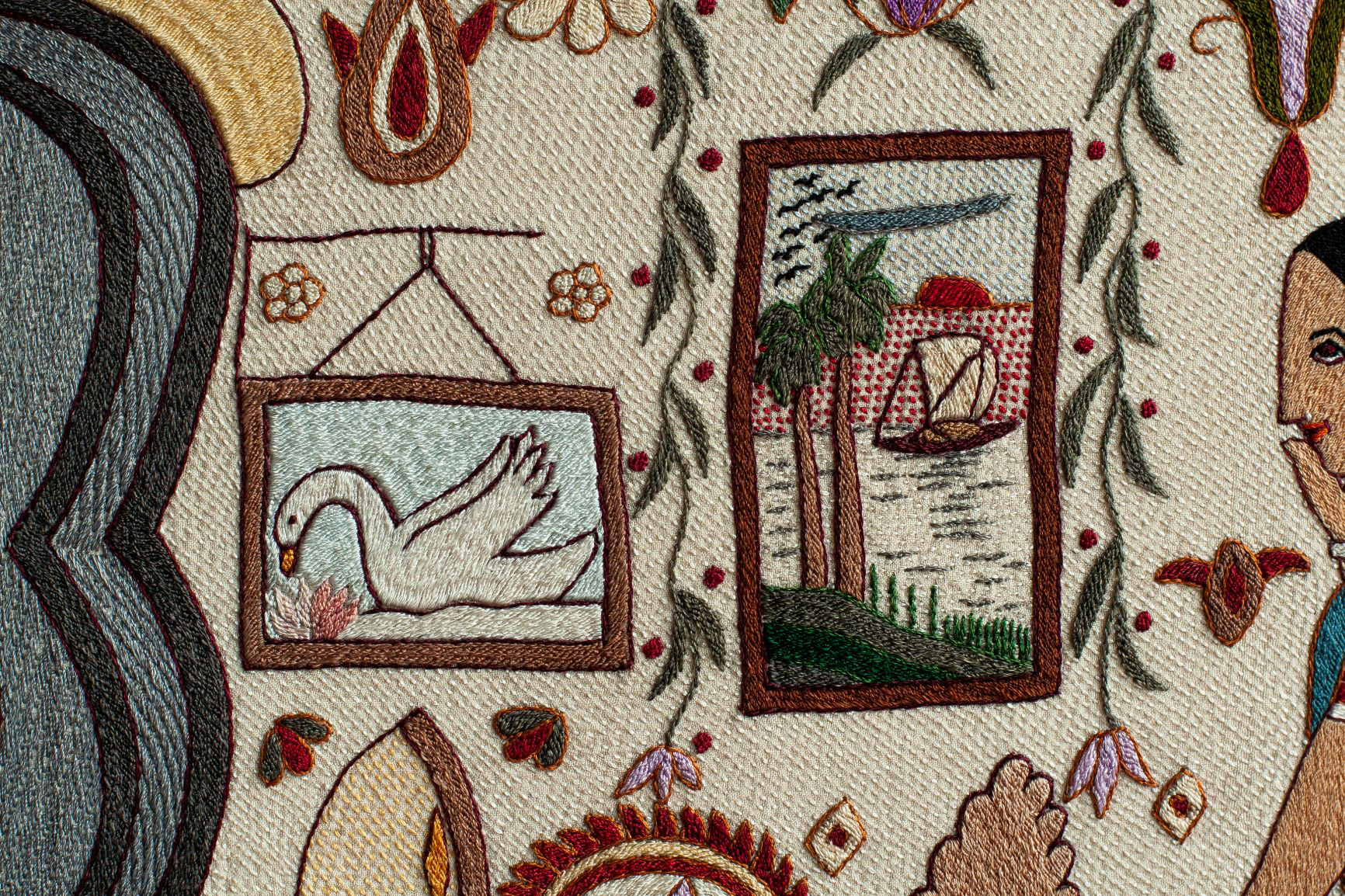
Motifs: Kantha showcases motifs important to and expressive of Indian and Bengali cultural and spiritual belief systems. The sun, lotus flowers, the ocean, trees, birds, animals, scenes from mythology and Hinduism, objects like mirrors, lamps, temples, boats, and combs, protective symbols, and messages all feature throughout Kantha embroideries.
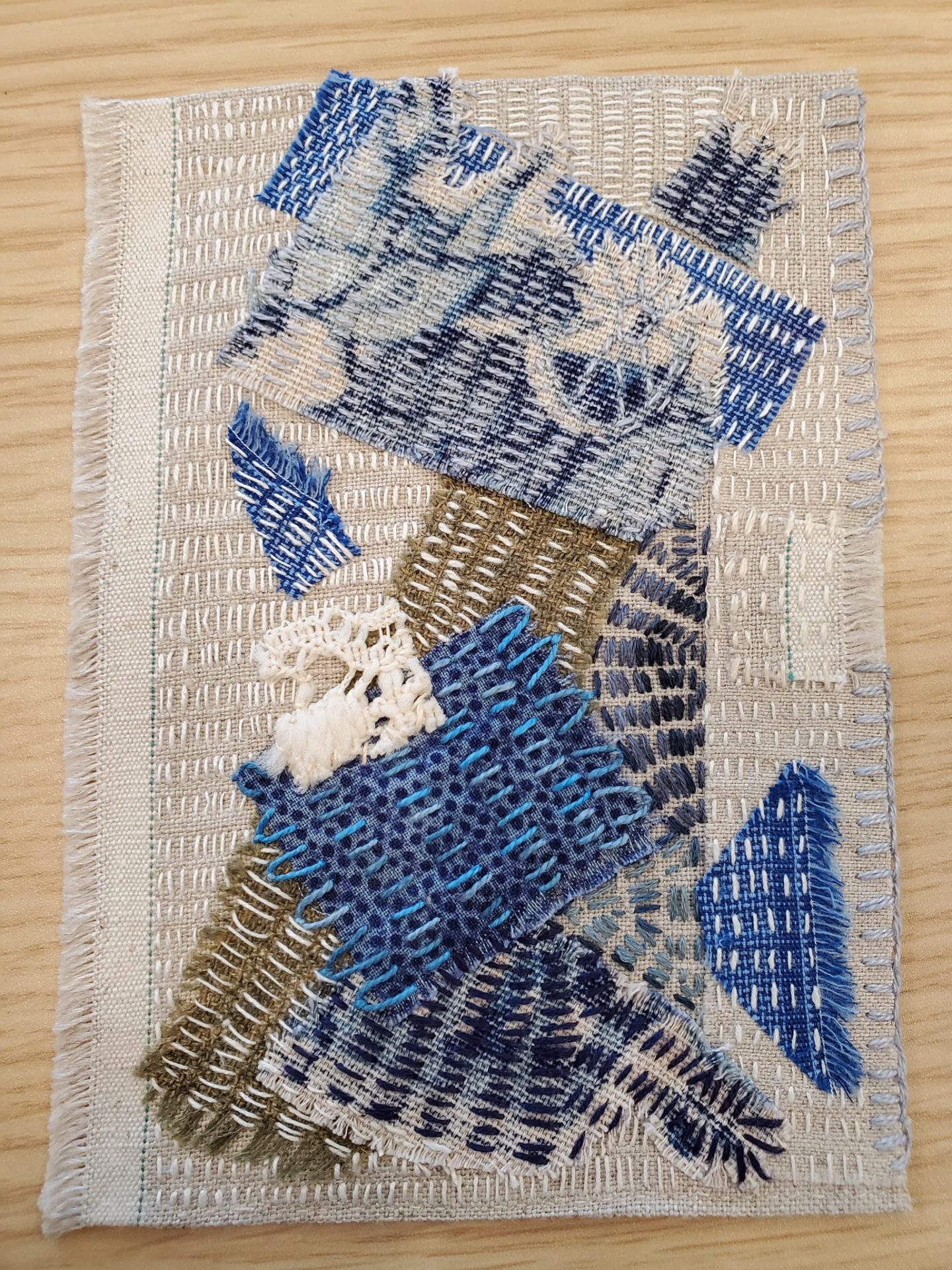
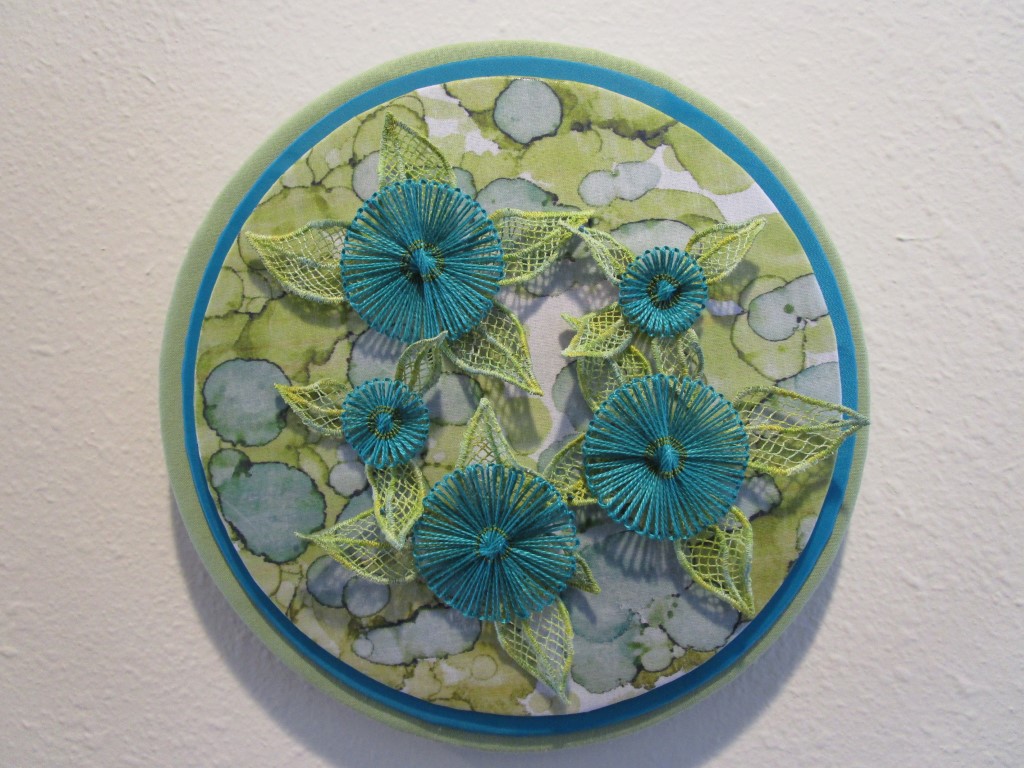
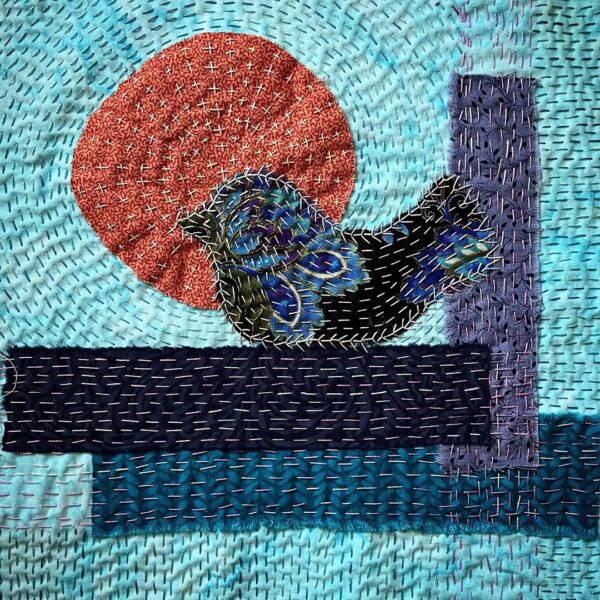
Interested in exploring more Kantha embroidery? Check out the free EGA Stitch-a-Long design from July 2022, “A Little Piece of Art,” a Japanese Boro and Indian Kantha piece (seen above).
Sources
(n.d.). Kantha Work. TRC Leiden. https://trc-leiden.nl/trc-needles/regional-traditions/indian-subcontinent/kantha-work
Sunder, K. (n.d.). The stories hidden in the ancient Indian craft of kantha. BBC. https://www.bbc.com/culture/article/20221020-the-stories-hidden-in-the-ancient-indian-craft-of-kantha
(n.d.). Kantha: The Story. House of Wandering Silk. https://www.wanderingsilk.org/kantha-history-and-meaning
(n.d.). The Complete History of Kantha Stitch: From Ancient Bengal to Modern Fashion. Desi. https://www.desiaadat.com/blogs/kantha-stitch-embroidery/complete-history
(n.d.). From Humble Beginnings: The Kantha Work of West Bengal. The Fabled Thread. https://thefabledthread.com/blog/rags-to-stitches-the-kantha-work-of-west-bengal
Craft Revival Trust (n.d.). The Embroidered Kantha. Google Arts & Culture. https://artsandculture.google.com/story/the-embroidered-kantha-craft-revival-trust/GgVBd2umdnlJLA?hl=en
Craft Revival Trust (n.d.). Bengali Kantha. Asian Textile Studies. https://asiantextilestudies.com/kantha.html
Kantha. (2025, October 10). In Wikipedia. https://en.wikipedia.org/wiki/Kantha