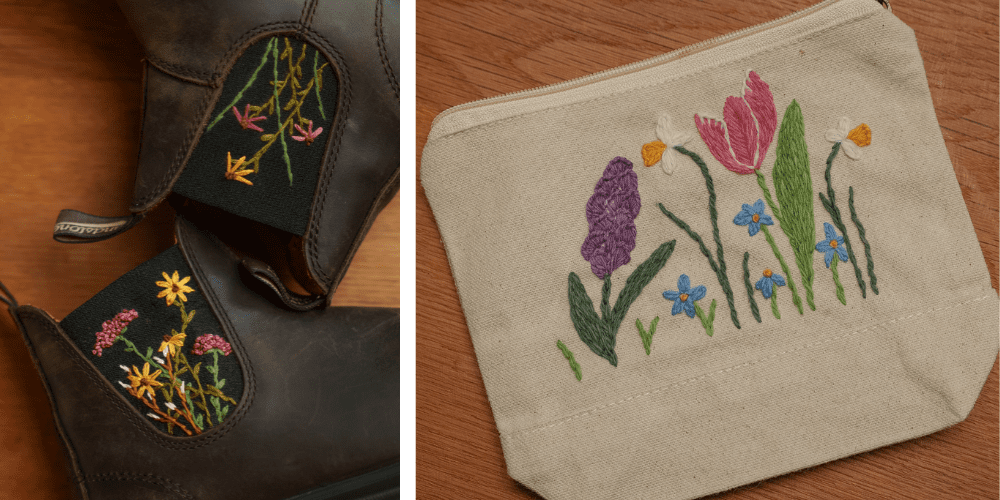
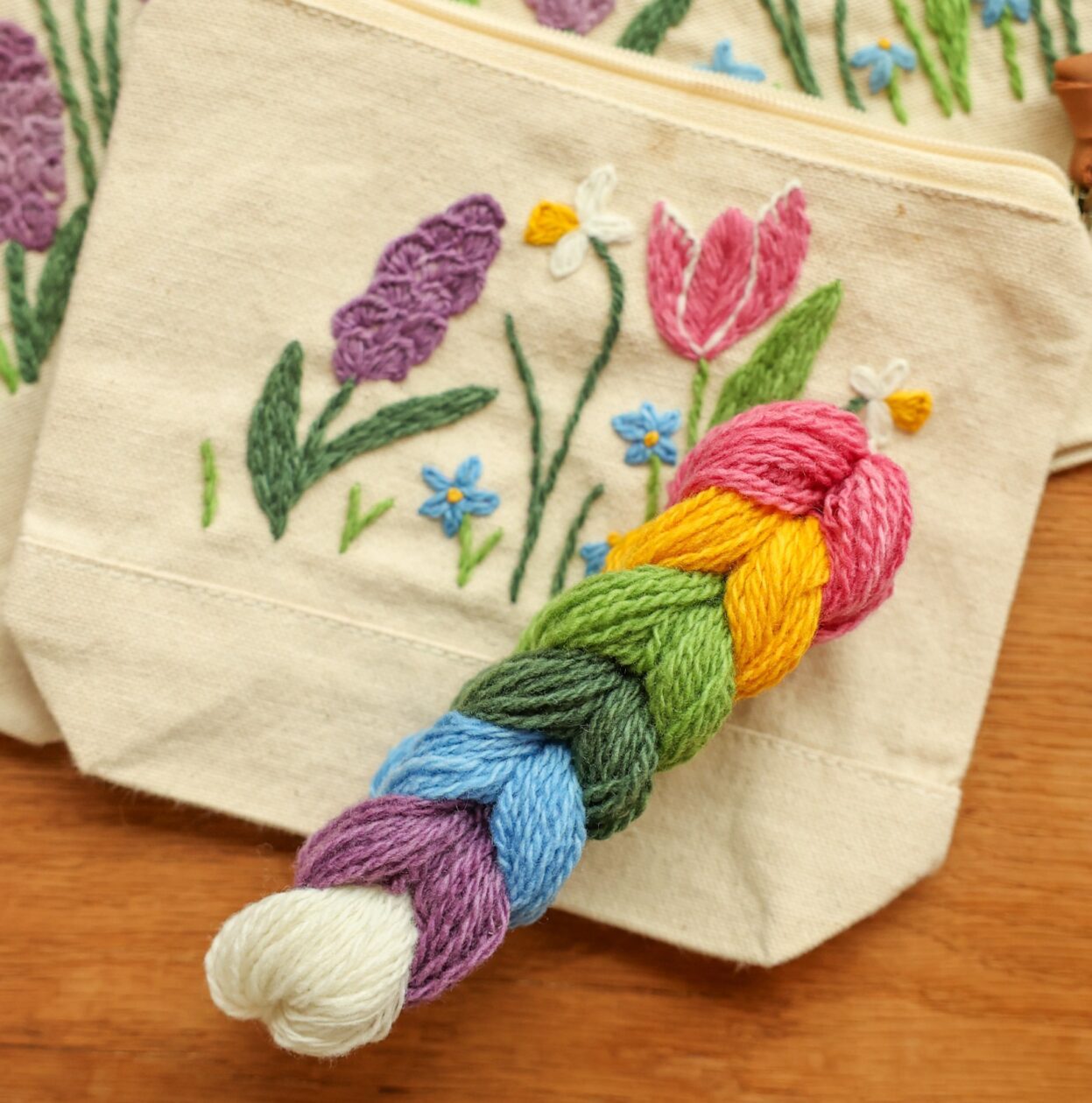
Meaghan Monroe and her family are the passionate design and dye team behind Subito Farm, which offers hand-dyed yarns, fibers, knitting and embroidery patterns, and kits for hand embroiderers and knitters. Meaghan has created two gorgeous patterns for the EGA community—the delightful Autumn Flowers Boots Embroidery for Outside the Hoop, and the new Spring Flowers Zipper Pouch. We wanted to learn more about how Meaghan translates her love of florals into embroidery designs and how she and her family capture the colors of nature in their hand-dyed yarn and embroidery threads.
What were your first experiences with needlework and embroidery? Did someone teach you, or are you self taught?
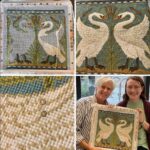
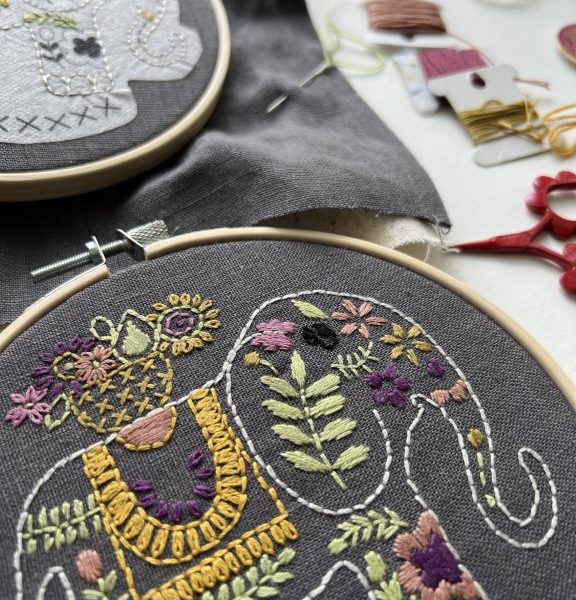
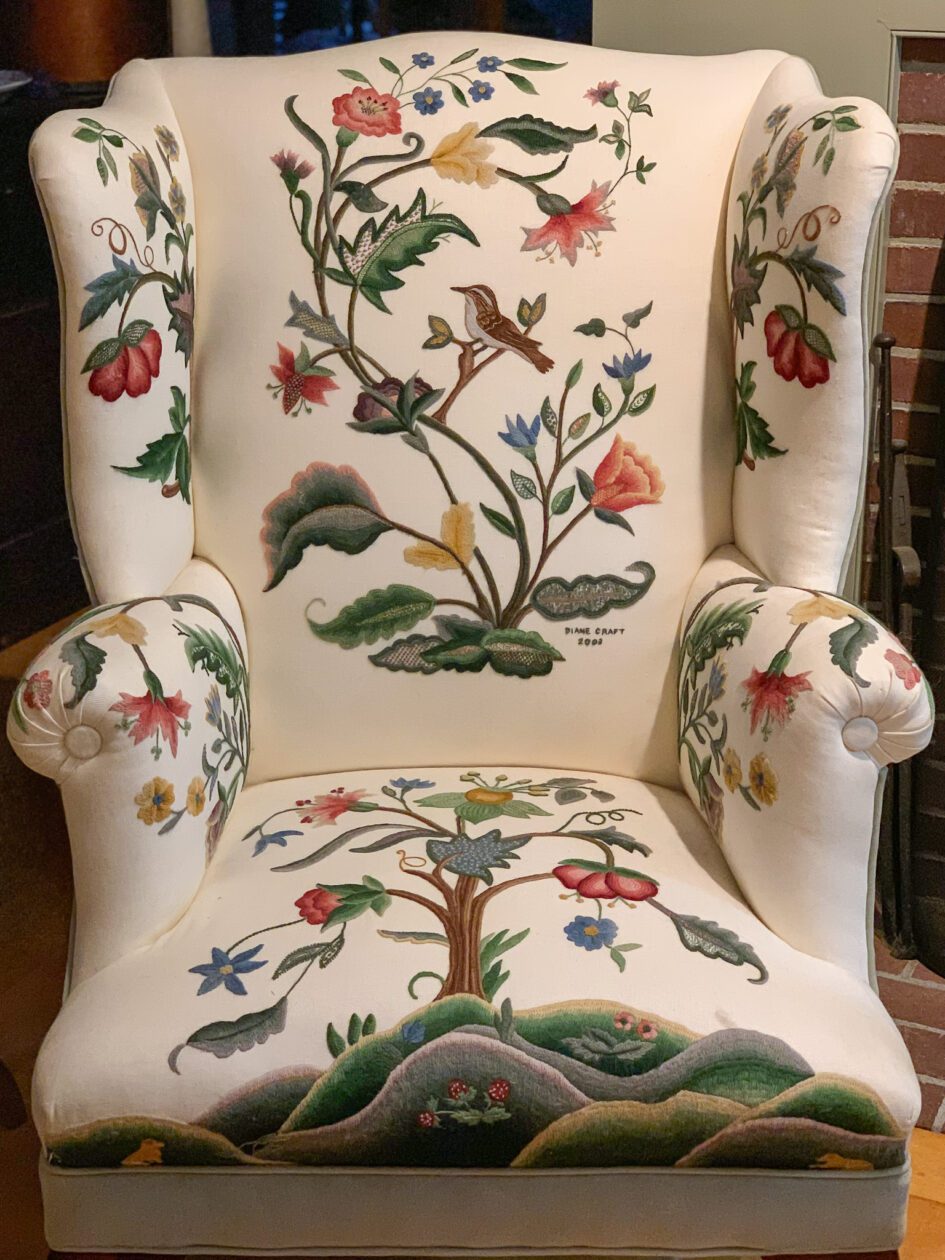
I suppose my first experience with needlework and embroidery was seeing all of the beautiful work my grandmother created and continues to create. She is a prolific stitcher, everyone in my family has at least one hand stitched quilt from her, all of the grandchildren have cross stitched samplers marking our births, and she has even stitched the upholstery for multiple wing back chairs with crewel embroidery (see below).
Even though I have been surrounded by needlework for most of my life, I didn’t stitch my own first project until around 2019. I started with a little kit with simple flowers I found on Etsy and I was quickly hooked.
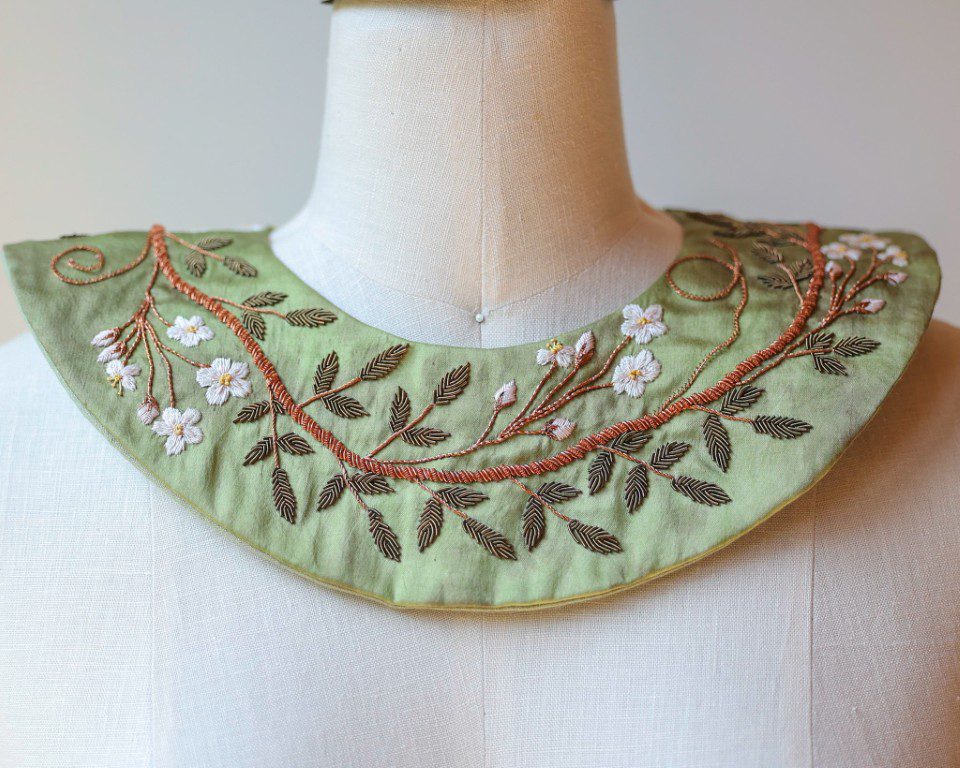
Over the course of 2020 I fell in love with silk threads and stitched a number of my own designs from a silk shaded portrait of a horse to a trio of elemental dragons. I also learned about different types of embroidery and stitched kits to learn goldwork embroidery as well as crewel embroidery. Since then, I have continued stitching whatever inspires me and finally started writing my own patterns in 2022.
Do you have a favorite style of embroidery?
What I love about embroidery overall is how many different styles there are and how you can apply each of them to create a different effect. I am drawn to the colors and shading you can create with silk threads and I absolutely adore the textures of crewel and goldwork embroidery.
Where do you draw inspiration for your designs?
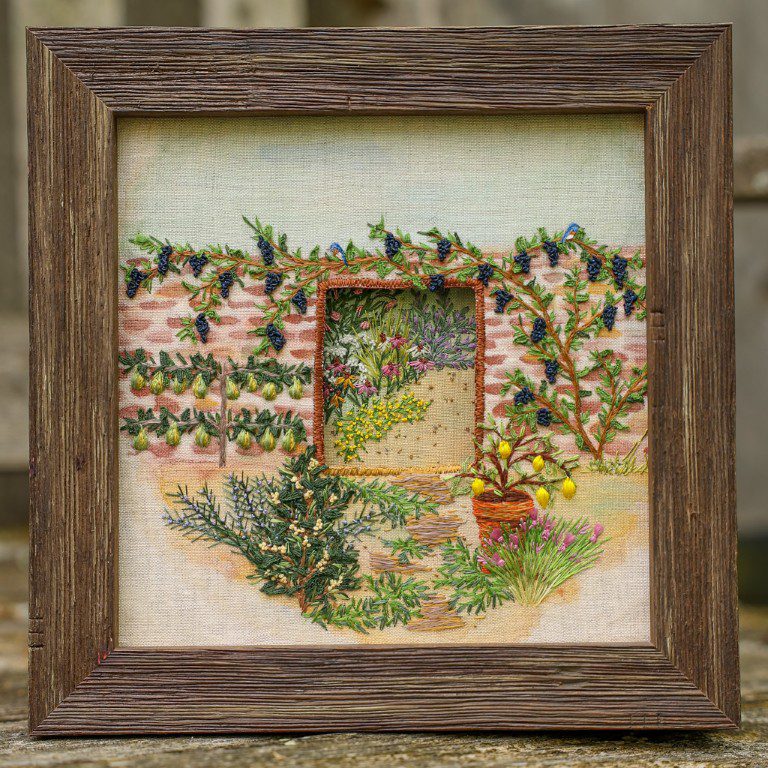
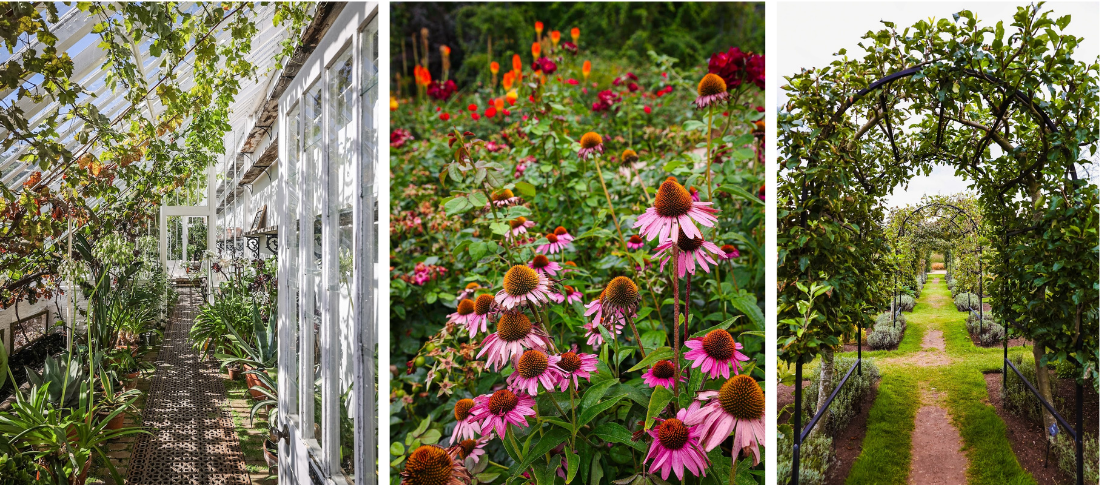
I am strongly inspired by nature, as so much historical art is inspired by plants. I absolutely love visiting gardens when we travel and take as many photos as I can. I also really enjoy researching my subject matter when I am working on a new project. Frequently, I design collections of patterns and they each have a theme tying them together.
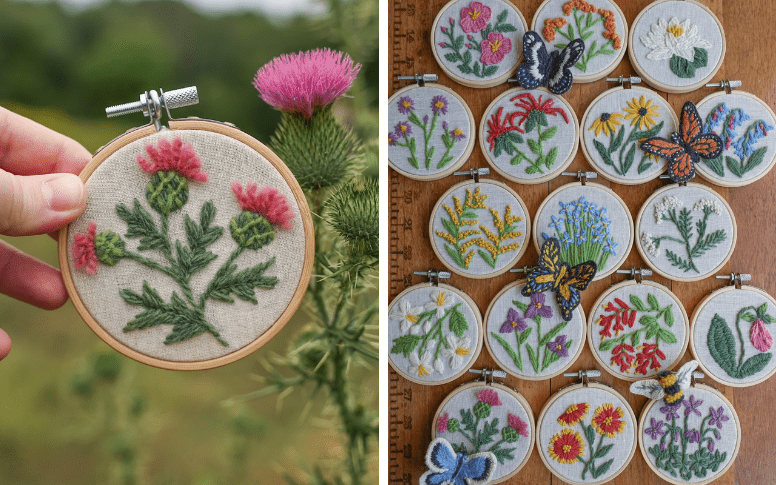
For example, I designed a series of small flowers that are each native flowers of the Eastern US, followed by a collection of stumpwork pollinators that would pollinate those plants. I am currently brainstorming a new set of embroidered tote bag patterns that will be inspired by antique scientific drawings of plants.
What does your design process look like?
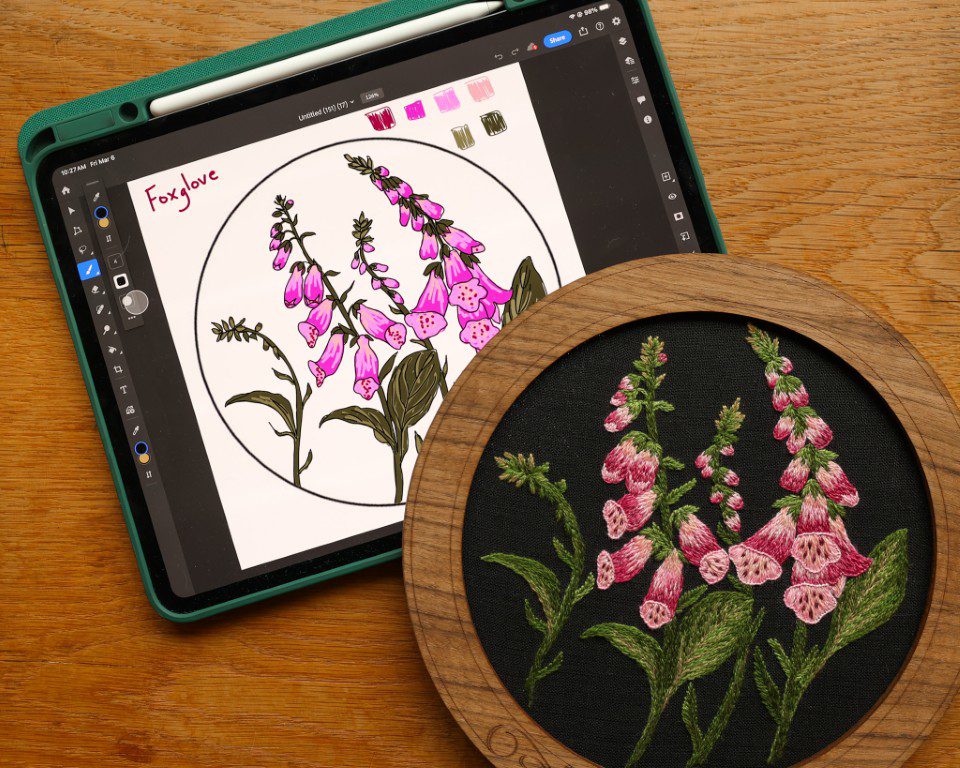
Once I have an idea of what I want to stitch, the first step is sketching the design. I like to draw out a design on my tablet before I stitch it to help with placement of different elements. Sometimes I will also add color to my drawing, especially if I am going to be dyeing new colors for a design.
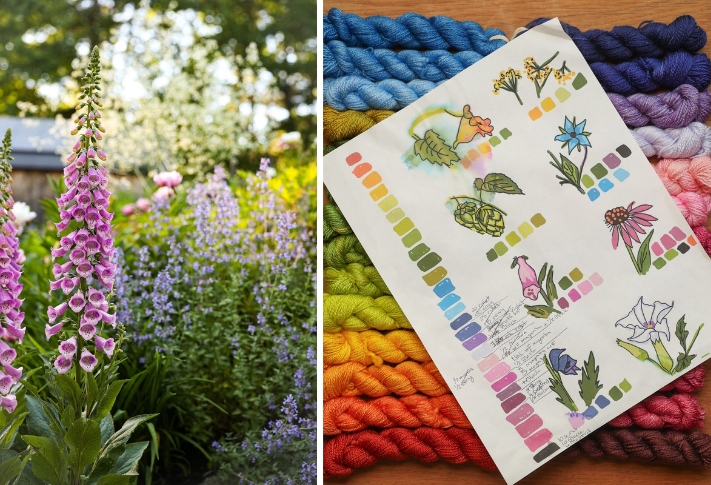
Next, I will pick out a palette of yarns. Whether I am dyeing them or choosing from my stash I like to select all of the colors I plan to use before I begin stitching. After that it’s as simple as transferring my design to fabric and starting to stitch. I tend to make specific stitch choices as I work up a project and sometimes this does require taking out part of a project before continuing.
Do you have a favorite design? Why is it your favorite?
My favorite design is always the next one. I really enjoy the process of creating something and bringing it from an idea into reality. Now, as I am most often designing with a kit in mind, I find the process of creating the design, stitching it, designing the packaging, assembling the kits, and finally getting to see what people make of it at our in-person shows to be incredibly rewarding.
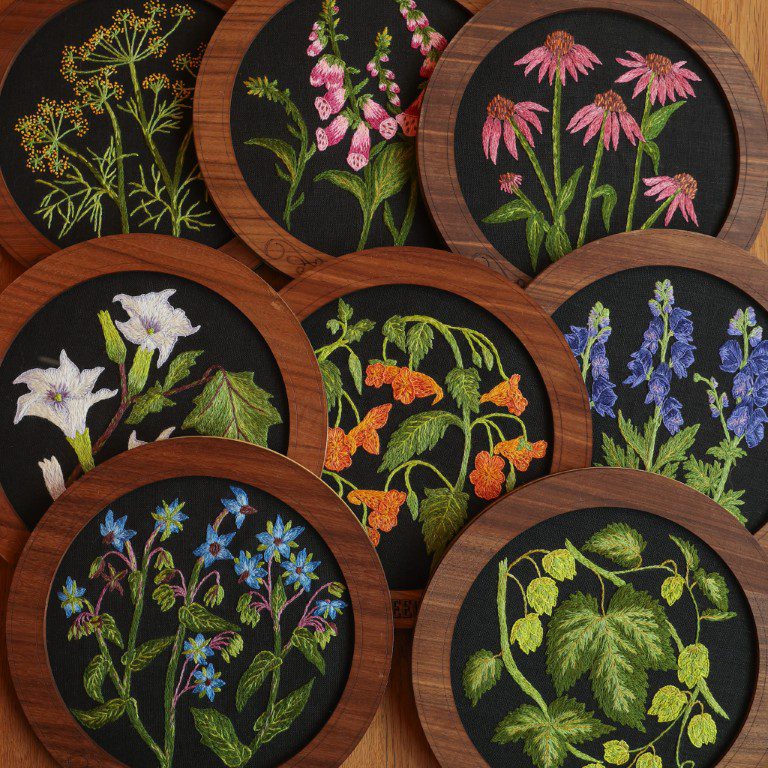
I am currently finishing up a new series of eight silk shaded embroidery kits that will be available for the first time in April. I had the idea about a year ago to make these kits because I love the process of silk shading and I think it looks incredible on black fabric. I really leaned into the botanical drawing/apothecary inspiration and chose plants with antiquated medicinal uses. These are my largest designs so far, each fits inside an 8-inch embroidery hoop. I am very proud of how they turned out and I hope everyone who sees them will be inspired too.
You are one-third of the family artisan team behind Subito Farm Designs. Tell us about your family, how Subito Farm Designs came to be, and what Subito Farm Designs offers the embroidery and needlework community.
My mom, Cindy, started Subito Farm Designs years ago when she designed her first knitting pattern. She dipped her toe into selling her hand-spun yarn at the local farmers market. The business evolved and we primarily sold knitting patterns and hand-dyed yarn as my sister, Sarah, became a knitting pattern designer too. The business has continued to grow and I am so glad to be able to add my embroidery kits to our fiber booth. You can find us in person at many of the sheep and wool festivals on the East coast of the United States.
My favorite thing to tell people about our booth is that everything after the spinning of the yarn we do ourselves. Sarah and Cindy design all of the knitting patterns, but they also developed all the yarn colors in our booth and dye the yarn themselves. Sarah does all the graphic design for the knitting patterns as well as my embroidery patterns, while I take all of the photos of our work. As for myself, I design the embroidery patterns, but I also dye the yarn, design the packaging, and assemble all of the embroidery kits. Our business is truly a labor of love and we are passionate about every step.
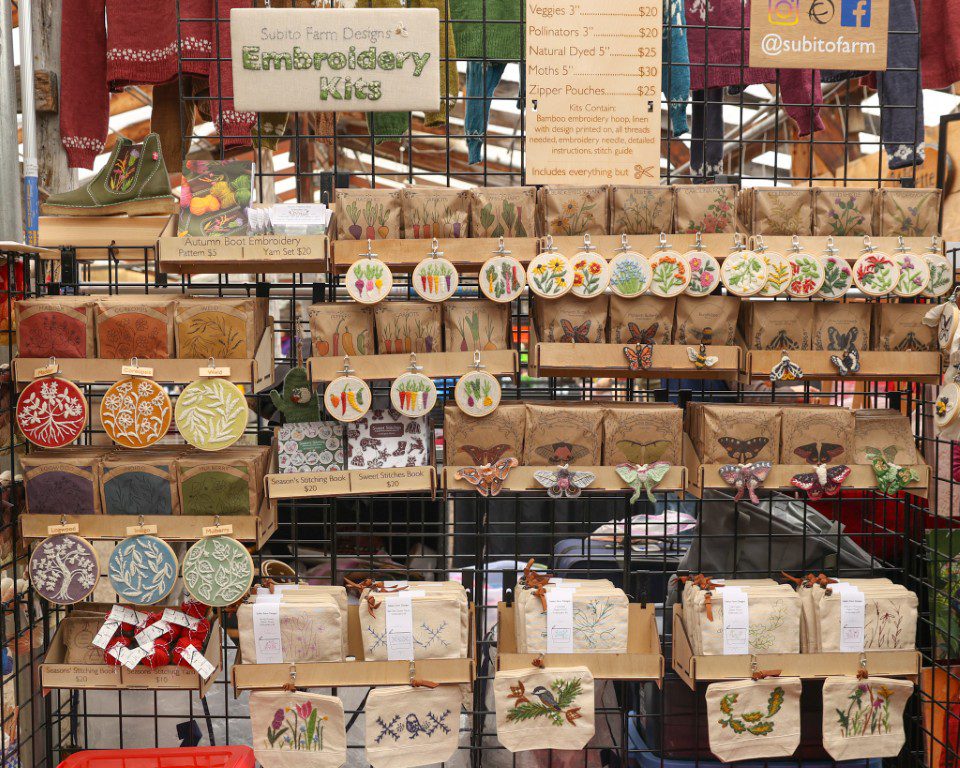
Despite working in different mediums all three of us draw inspiration from nature and color. If you come to see our booth in person you will find baskets of hand dyed yarns that we source from mills in the US, pattern books filled with Sarah and Cindy’s knitting designs, and of course my embroidery kits. We all strive to be experts in our chosen medium and bring that to our designs.
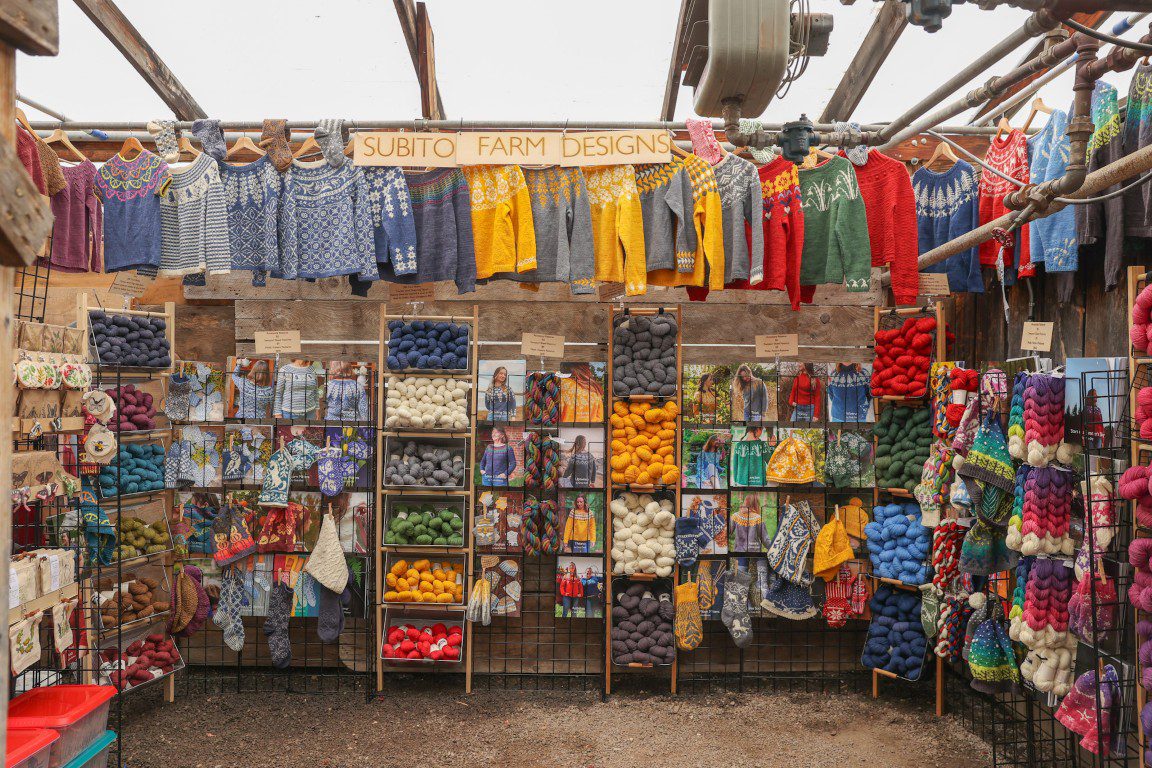
Our booth at fiber festivals is full of color, fiber, and knitting patterns!
Subito Farms offers a lot of linen, wools, and wool threads, and most are sourced and processed in the U.S.—as locally as possible. Can you tell us a little bit about the process behind your fibers?
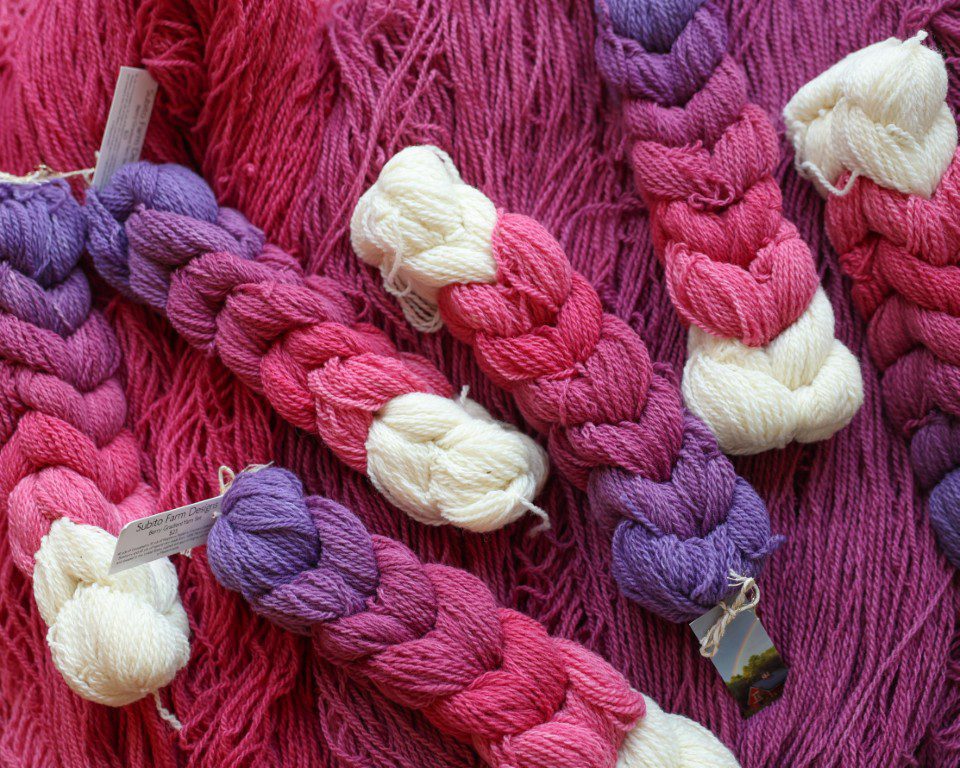
We began with two main yarns for Sarah and Cindy’s knitting patterns. Since Cindy started as a hand-spinner, she is very knowledgeable about the characteristics of the yarn from different breeds of sheep. As a result, we have become somewhat picky about our materials. The first yarn, Estabrook, is a merino wool yarn sourced from a mill in Virginia. Merino wool is somewhat of a no-brainer in knitting since it is known for its softness. The second yarn we named Foss, which is sourced from a mill and farms in Wyoming, and is a Cormo wool yarn. Cormo is a breed of sheep that originated from crossing merino sheep with Corriadale sheep. As a result, Cormo wool is soft from the merino and bouncy (resulting in a rounder squishier yarn) from the Corriadale.
When I started thinking about making embroidery kits, I stitched in both our Foss yarn and our Estabrook yarn and I was surprised to find that despite the Estabrook yarn being chunkier I much preferred it to the Foss because of how the individual stitches laid together when it’s used in a project. The Foss yarn turned out to have too much stitch definition for me—a good thing in knitting, but distracting in embroidery.
We do try to source our materials from the US as often as possible to reduce our ecological impact and stay as connected to all aspects of the process as we can. One place I have had to compromise is in the linen fabric my embroidery kits use. I love to stitch on linen and wanted my kits to have a quality fabric, but linen is not grown or processed in the US on a commercial scale. So my compromise was to source high-quality European linen from a small company out of New York.
Within the last year, I have also added a new embroidery yarn, which is sourced from a mill in the UK. I specifically wanted a yarn that was 50% mulberry silk and 50% wool because I love the color saturation and sheen you can get with silk threads and the texture that wool threads provide. Unfortunately, there are no mills in the US producing this type of yarn. My hope is in the future to work with a mill in New Hampshire to eventually produce this type of yarn here with US wool.
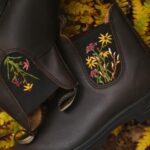
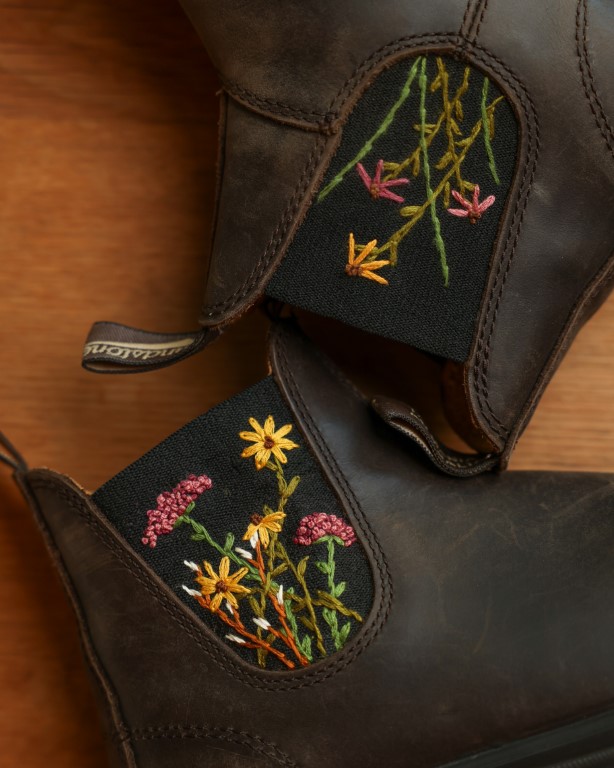
You designed the popular Outside the Hoop: Autumn Flowers Boots EGA published last year. What inspired you to embroider on a pair of Blundstone Chelsea Boots—and what advice do you have for beginner embroiderers interested in tackling embroidery outside the hoop?
Blundstones or Duckfeet boots are my go to boots to wear when we are vending at fiber festivals and that little band of elastic seemed like the perfect place to showcase my love of embroidery! My best piece of advice is to start small. You can always add more to your design, but if you set yourself a manageable amount of embroidery, perhaps even that you could finish in one sitting you will be more likely to finish. That way you can wear or display your project right away and maybe that will inspire you to try something a little more complicated next time.
What is your favorite piece of embroidery advice?
Don’t be afraid of mistakes, just stitch the project! I have started teaching a few embroidery classes and it always surprises me how often my students are afraid of making a mistake or changing something in my pattern. Mistakes happen, but as with many crafts, at the end, it is likely you are the only person who is going to see it. Hand stitched embroidery is often beautiful not because of its perfection, but because you can see all the variation that shows you it was made by hand.
Is Subito Farms participating in any upcoming events you’d like to share with EGA’s readers?
You can find our full calendar on our website, but this spring you can catch us in person at any number of fiber festivals including Nash Yarn Fest & the Fiber Witch Festival in April, as well as the Maryland Sheep and Wool Festival on the first weekend in May.